
Library / Podcast
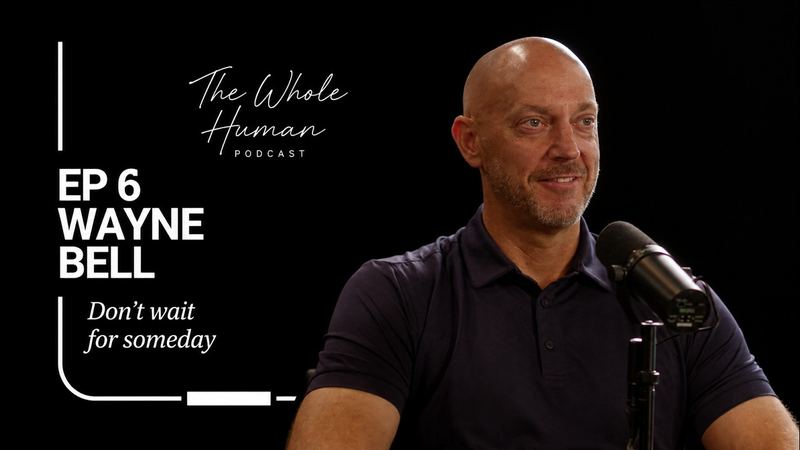
In this episode
Andy and Jay sit down with Wayne Bell — a self-described “recovering CEO” who has run companies a number of times and now helps founders and CEOs get themselves and their businesses ready to exit — and a two-time cancer survivor. The conversation moves from the things he hinged his worth to and had to let go of, to the identity crisis of selling a business, to the “bonus round” apathy that followed his first diagnosis and the inner circle that pulled him out of it. Along the way: expectations versus agreements, why buried emotion costs the body, AI and human connection, and why “someday will never come.”
Key takeaways
- “If you wait for someday, it’s not going to come.” Two rounds of cancer stripped away Wayne’s habit of deferring life until the next finish line or liquidity event. His lesson: start living the experiences with the relationships that matter most, now.
- Expectation minus reality equals disappointment — perpetual disappointment. Andy’s equation for marriage and fatherhood; Wayne’s version is expectations vs. agreements. Uncommunicated expectations breed resentment. Agreements turn it into a two-way dialogue.
- Unhinge your worth from your performance. Wayne spent decades playing not to lose; Andy tied self-worth to results and got dopamine for it. Both had to learn that worth “can’t go up, it can’t go down. It is who I am.”
- Trust, loyalty, commitment — and genuine care. The fourth piece Wayne found missing. Without two-way genuine care, the other three fracture in hard times, and he has unhinged from people who lacked it.
- “If you bury emotion long enough, it’s going to create disease in your body.” Wayne believes his stoic, take-it-all-on posture cost him. His advice: find an inner circle, a therapist, body work — but do not hold it in.
- Alone is not the same as lonely. Leaders surrounded by people can still be lonely, because few people know them at depth. Andy’s honest question: where do you feel most alone, and where do you feel most lonely?
- Selling a business is an identity crisis. Most founders can’t say who they’ll be after the exit, and that becomes the biggest risk to the deal. Wayne has sat in that seat: 14 years in his first company, and then “now what?”
- Purpose evolves, and “finishing” needed redefining. Wayne’s purpose now is “to help set people free.” Looking back, every at-bat was him creating value; he just had too-tight finish lines to see it.
Chapters
Transcript
Auto-generated from the episode and lightly edited. Timestamps mark the start of each section; a new line marks a change of speaker.
00:00
The time runs out, and someday will never come.
Expectation minus reality equals disappointment. Perpetual disappointment.
The fragility of the experience of cancer, and the fragility of life — it just opened my whole mind: no, there is an amazing, beautiful life ahead of me.
I’m here, a father to these children, for a reason, and I need to just really focus and be more aware of who these kids are and who I am with each one of them individually.
You’re in a conversation with people and they’re meeting you for the first time. What would you say you do? What would you say your job title is, or what would you say that you love doing right now with your life?
01:00
That’s a great question. Well, my name is Wayne Bell. So that’s my name, but that’s not at all who I am. Who I am — I would say I’ve been doing a lot of work on that. I’d say professionally, I’m kind of orienting myself around the term “force multiplier,” because with the work that I’ve noticed I’ve done over the last couple of decades, we’re creating a lot of value. So that one plus one equals five. I would also say I’m a bit of a recovering CEO. I’ve been a CEO a number of times, and now I’m not, and I’m helping CEOs with getting themselves ready and their businesses ready to exit — a very fulfilling career shift. I do a few other things too, but that would be what I do professionally. And then personally, I would say I’ve also been doing a lot of work over the last five or six years around really who I am and what is the purpose of life. I’ve gone through some pretty crazy stuff the last few years, and if you wait for someday, it’s not going to come. So you have to start living life now, in all dimensions of your life, personally and professionally. At some point I’m going to write a book called Unhinged, and I’m going to talk about all the things I’ve disconnected myself from that didn’t serve me, and where I’m moving forward to.
02:31
Yeah. Let’s go back to the beginning of what you started to connect yourself to to find a sense of worth, identity, approval, success. Let’s go all the way back, since your future book is Unhinged. I think it’s appropriate to go back to the original story of how did you get attached to things? How did you get hinged to things, and what were those?
I would say that I’ve spent most of my life playing it super safe — almost playing not to lose — and I’d still win. I’d still win a lot of the games by a free throw, if you will, but I was always trying to manage the risk of playing all out. And I would say, if I go back in time, although that serves you well — looking at all the risks and managing those and coming up with all the scenarios — you can overthink a lot. We were talking earlier about getting your mind, your thoughts, your heart, and your gut or your instinct all aligned. And once you can get that alignment, magic can happen. I’ve been working with a coach, an amazing guy; his name is Devin. Two things he’s talked about. He said your thoughts create your feelings, your feelings create your behavior, and your behavior creates results. So if you don’t like the results, backtrack, and it always ends up where you’re thinking. So your thoughts create your reality and your words create your world. And once you can connect to those things, you really start to unlock a whole lot of positive and powerful things in your life.
Yeah. I wonder, what were some things that you would say you hinged yourself to, kind of like Wayne’s talking about, that you’ve had to learn to unhinge in your personal life? I think that’s a great question for all of us to chat about.
04:17
Like things that I’ve locked on to in the past that essentially I had to let go?
Yeah. Or that you feel like don’t serve you anymore moving forward.
I feel like this creeps in a lot still, but I feel like I’ve had to let go of this a lot, and that’s perfectionism — with marriage, fatherhood, work, and self-help. I can get a little too perfectionism-driven with it, and I’ve had to learn to really let go of that. I’ll give you the dumbest example. I hate social media, but for my business it’s necessary. I hate posting things, and I’ll sit there with this beautiful post, and I’ll sit there for days thinking of a caption to put on it. But the problem is, when I look at social media posts, I don’t ever read the caption on anything. Yet here I am obsessing over this has to be perfect, it has to be a certain way. So I’ve had to really learn to let go of things like that. When it comes to marriage, I remember there were so many times where I had expectations of marriage — this is what it should be, so this is what I’m going to drive it towards — instead of, for me, where does God want this marriage to go, instead of what the expectations of the world are for marriage. Or as a father, too. I’ve really set my expectations high for myself with fatherhood, and I’ve had to really let go of that and just know I’m here, a father to these children, for a reason. And I need to just really focus and be more aware of who these kids are and who I am with each one of them individually, versus, I’m a 40-year-old man and a Christian entrepreneur, so I need to fit in this box and everything needs to be this way. Instead, I’m constantly trying to let go of that and just really focus on — I’m a different dad than you are, a different dad than you are, and my kids are different than your kids and vice versa — and just really leaning into today, and where my kids are at today and where I’m at.
06:45
What you’ve said, and your definition of what it means to be a dad for you — I thought about this equation that I bring up inside of my head and often talk about with couples: expectation minus reality equals disappointment. Perpetual disappointment. And it’s important, I think, for me and for us to have an accurate assessment of reality and make sure that the expectation matches that. So I could expect my spouse to be the kind of person that I want them to be, but that’s not actually who they are. And if that’s not in alignment, there’s perpetual disappointment, and oftentimes bitterness. And I think one of the things I’ve had to unhinge in my life — that I hinged to early on, and it was actually very important, and I think it brought me a lot of success and admiration — was tying my performance to my sense of self-worth. I think those things got hinged very tightly. And it did not help that when I did that, I actually got tremendous amounts of approval. I got super high dopamine hits, and it felt really, really good. But where it started to break down was really when I first got married and started having kids, and the pressure started to build even more. And I realized the measure of performance — I couldn’t match what was expected of me or what I needed to be. And then when I would do well, I would feel well. When I would do bad, I would feel bad about who I am. And I really had to, early on in marriage and with kids, start to peel and unhinge this idea that my worth comes from and is derived from my sense of performance. No — my worth and value is consistent. It can’t go up, it can’t go down. It is who I am.
So that’s one of the things in my own life that I’ve kind of unhinged, for lack of better words.
08:34
Yeah. That triggers a thought around expectations versus agreements. Steve Chandler, in town, is a pretty well-known coach, and Devin brings it up too. If you have a bunch of expectations, whether they’re communicated or not communicated, without agreements, then they lead to disappointment. And so I’ve been really focused on: okay, do I have an agreement there? Is that a missed expectation or not? And really unhinging from the fact that I had all kinds of expectations of people and I never communicated them well enough. I’m shifting it to agreements with them, so it’s very clear, and it then becomes a two-way dialogue, and all of a sudden it’s a great relationship.
Why is it so easy to go to mind reading? I guess what you’re describing is this mind reading of, well, people should just know what I think and feel, versus the vulnerability of communicating what you think and feel. Why was that so hard for you, maybe, Wayne, to be vulnerable and make a stand for what you need and want and put it out there?
Gosh, probably decades of making sure that everyone else was okay,
09:46
and then I would take whatever was left. And that will take a toll on your body — physically, mentally, spiritually, emotionally. When I realized that it’s okay to be a little bit selfish — a little bit concerned with what you need — and then really advocating for yourself… I didn’t advocate for myself for so many years because I didn’t deep down believe that I was enough. And that probably goes all the way to childhood; there’s some broken family stuff back when I was young. But once I realized, stripped down: no, you’re more than enough. You’re a miracle of God just the way you are. Then all of a sudden stuff started unlocking, and you see life totally different.
What did you start to see differently in life that maybe has brought you freedom as you look back?
Freedom is a great question. So you can only feel freedom in the present, and so I try to live in the present to be free. Because the past — you can’t do anything about it. You can learn from it. And the future doesn’t exist. And I spent most of my time, when I realized it, in the past, recycling things all the time, or in the future, trying to hope that I can figure something out or outmaneuver or whatnot. And none of that really exists.
11:16
And when I finally realized, okay, today, right now, exists — enjoy who you’re with and what you’re doing. And make sure that who you’re with is who you want to be with, which is another thing I’ll say in a minute about being unhinged. But that’s freedom: being able to live in the present. And I would also say, professionally, I used to think trust, loyalty, and commitment were the three things — if you can align yourself with people you have trust and loyalty and commitment with, you’re golden. And what it was missing was a really critical fourth piece, which was genuine care. You can have trust, loyalty, and commitment broken in good and bad times, and then it fractures relationships. But if you actually have genuine care for that person, and it’s two-way, it kind of wraps a cord around all those, and it really can’t be broken. And so I’ve unhinged from a lot of people that just didn’t have genuine care for either me or the people that I cared most about. It wasn’t necessarily that they’re bad people. It’s just they weren’t aligned with who I am anymore.
I love that you talk about the present moment, because I feel like the last five years of my life has really just focused on trying to make sure I’m building awareness and focusing on the present. I actually was preparing this whole talk for this thing, and it was on that. And the more I dove into it, the more interesting it was. I’d love to hear your guys’ thoughts on this, but I came up with this semi-analogy or symbolism for it. When you go see a movie and then you see a friend the next day, or you talk to your spouse or your sibling or whatever about it, they’re like, “Oh, tell me about the movie.” You’re not usually like, “Okay, well, it started this way,” and then go through this chronological sequence of it. You’re usually like, “Oh man, there’s this scene that was so cool where Schwarzenegger did this, or Matthew McConaughey did this.” It’s these little bursts of moments that you’re really excited about. And that’s kind of how our brains are wired. When you look back at your life, usually it’s not this start-to-finish chronological story. But then we try to force ourselves to do that a lot. We mentally force ourselves to think chronologically, but we’re just not really wired that way. And then what happens is we force ourselves to look backwards, and then we get stuck there, and we kind of trap ourselves in the past. And then when we get out of that, we force ourselves into a future of goal-seeking and drive. And then we get stuck there, in something that hasn’t even happened. And then what ends up happening is all those flashes of things — like the movie, Matthew McConaughey did this and whatever —
14:14
it’s like even thinking of your wedding day. You’re not thinking, well, I got up that day and I ate breakfast and then I drove here. You’re thinking, I remember this moment where I was super nervous, or I remember this moment where my friend said this thing, or I remember the first time I saw her coming down the aisle. You have all these ingredients, and these ingredients are what actually make your whole story. And if you’re just stuck in the past or stuck in the future, you’re not creating these ingredients to be able to create your actual story. And if you’re lacking any sort of that, then your story is going to suck. Your story is going to be really nothing.
So biologically, human beings are primed for two realities of life: pain and longing. And I think that’s what pushes us, oftentimes, into the past and the future. Our pain keeps us captive in the past, and our longing keeps us captive to the future. And when we don’t resolve our pain of the past — I know a lot of leaders who often are like, “Hey, bad things happened to me. Don’t really need to talk about it, because it’s in the past.” And they don’t understand that when you don’t deal with the past, it handicaps you from experiencing joy and pleasure in the present and the future. And their caveat to dealing with their pain in the past is getting stuck in the future of the ambition, the chase, the hunger. I do think there’s a meaning and purpose to each one of those stages: the past, the present, and the future. The past — how we can approach that is with curiosity and compassion. How do we look back and become curious about our story? Why did that happen? Why did I think that way? To understand more about who we are and have compassion on our shortcomings and also our imperfections. In the present, I think it’s really peace and contentment — to realize not only am I enough, but I have enough. That is the feeling in the present that you’re describing, that most people say, what does it mean to live in the present? It means to have a sense of overwhelming peace, overwhelming contentment, that I am enough, that I have enough, and that everything is okay. The future, to me — I love living in the future sometimes and dreaming, because it’s about excitement and hopefulness. And I think if you don’t live in the future, it’s very hard to get excited about the life you live, because the future is bright and it’s exciting. So I do think we live in the future to avoid the past, and we bypass the present. But there are ways that we can dip our toes into each one of those through time. But I do think, like you’re describing, most times leaders miss the present moment. And I’d be curious — you’ve been a CEO, you work with a lot of CEOs as they transition in business. I would love to understand, when you work with some of these leaders who transition out of business or sell their business, what’s the journey that you see them emotionally go on, and how does that relate to the journey you’ve been on?
17:19
So, inevitably, there’s an identity crisis when you sell your business. And that selling could be that you sell it to your kids, or you do an ESOP, or you do any kind of transition — but all businesses will transition, because we’re not going to live forever. So we spend a lot of time with founders and CEOs getting them ready: what is it going to be like, personally and professionally, after the transition or the succession or sale? And most don’t know the answer, and then that becomes the biggest risk of the deal, because their whole identity is still tied into it. When I left the first business — I’d been there for 14 years — I didn’t realize that my identity was still there. I got out and I’m like, now what? And so I’ve been there. I’ve sat in that seat. So I really try to press into that, and then really help them understand what their yeses and nos are really going to be to make that transition happen — their required outcomes, their preferred outcomes. And that really takes them through this journey of, okay, what can I really envision doing? What am I going to do afterwards? And what is the business going to look like two or three years after I leave? And we help them visualize that.
And then you can find out: are they ready? And if they’re ready, then you can get the business ready. And then you can take the value, create that value, and talk about that story to the potential buyers out there.
Who asks them what they want, what they need, where they’re…
Not very many people.
Not very many people.
18:50
And what does that do to these leaders, and for you in your own journey? Because you are, as you described, always making sure everybody else is taken care of, and not really asking yourself, and not having the right tribe in your life who’s going to intentionally go, “Hey, I can tell something’s off. How can I show up for you? What do you need?” To live in a world where we don’t have a tribe that pursues us in that way — what does that do to our soul? What does that do to our sense of vitality?
So, getting really personal, I got to the point where I would tell people — they would say, “What’s next?” and I’m like, “I’m in bonus round.” And, like, what does bonus round mean? It wasn’t until — I actually am a cancer survivor, and when I got cancer for the first time, afterwards someone asked me, “So what, you beat cancer. What do you want to do now?” And I’m like, “I’m just in bonus round.” And what does that mean? They kept peeling the layer back, and what happened is I lost hope for anything exciting in life and became apathetic, but I didn’t recognize that. I just called it bonus round. And this one person was like, “Well, that’s crap. There’s a lot to live, and you’re young, and life is beautiful.” And it snapped me out of it. You’re right. This taste of life, especially after the fragility of the experience of cancer and the fragility of life — it just opened my whole mind: no, there is an amazing, beautiful life ahead of me, and I’m going to pursue it. And that’s when I started really getting into helping my body get better, helping my mind get better, seeking out coaches, seeking out my tribe. I had my close inner circle, and I really leaned into them and they really leaned into me, and it just changed everything. And it’s still changing and evolving.
20:44
How would you say they leaned into you in a way that meant the most to you?
Well, I’m part of YPO, and part of that is just having such vulnerability, but also the confidential circle of influence that you have with them. They know everything about you. They know your flaws, they know your strengths, and they’re willing to come alongside you and almost be shepherds to help you live a life that you want. And then they’re also willing to ask you the tough questions, like, “Hey, I don’t think you are.” And they’ll hold you accountable. That made a huge difference. And seeking out a real transformational coach — I hesitated for many, many decades to do that, and it’s been a game changer for me. It’s been a game changer for me.
21:34
Yeah. I think leaders get confused between the feeling of being alone and the feeling of being lonely. And oftentimes they don’t identify that they’re lonely, because they’re actually not alone. They have a ton of people they’re around. Everybody knows who they are. They have their communities, their tribes, and they have the notoriety of that. So if you ask them, “Are you lonely?” they’re like, “No, I’m not lonely, because how could I possibly be lonely? I have all these people in my life. I’ve got a family. I’ve got kids.” But if you distinguish for them — well, there’s alone, which means that you’re alone on an island, that it’s only you. Or there’s lonely, which actually means that there are a lot of people around, but not many people know you at a level of depth that really is your authentic self. And I do think it’s important for leaders who are listening to this to distinguish those two and just ask that honest question: where do you feel most alone, and where do you feel most lonely in life?
Yeah. Just another aside — there’s a recent conversation I had with another friend and CEO, and he’s like, “I don’t even know if I know how to have fun anymore. I know how to work, and I know how to pursue outcomes and deliver and create these amazing products or services or companies or entities, and there’s a destination. I don’t know if I know how to have fun when there’s no destination.” And I challenged him, and we had this beautiful conversation — it was actually today — around, okay, we’re going to design what fun looks like. And it was hard at first, because we’re so driven to be perfect and to deliver and to come up with the next idea or the next company or whatnot, and just keep innovating and being that entrepreneur. And we seldom stop and actually say what actually brings joy with no outcome or destination. And we just had a beautiful conversation around, let’s make music, or let’s go on an exploratory hike where we don’t really know where we’re going to go, and see nature, and maybe see things that no other human’s ever seen, and really just expand our minds and our hearts differently, with no outcome or destination. It was a cool conversation.
23:48
I love this idea of play and fun and adventure, but you’ve gone through some really hard stuff in your life. I mean, you talked about being a cancer survivor. That’s not a time when you think about abundance and play and fun. You think about survival, literally. And you’re the personality, Wayne, knowing you — and you described this in your story — where you’re trying to take care of everybody. Talk to us emotionally about what that was like for you, to lose the capacity to show up in those ways and have to be so dependent on others in life.
Well, yeah. I think a message that I want to make sure everyone knows is: if you bury emotion long enough, it’s going to create disease in your body.
And so, you know, I was this stoic. I’m going to take it on. I’m going to bury it. I’m going to not let anyone see any pain whatsoever. And I think I paid the price for that, because it manifested in cancer — not once, but twice. The first time, it was a wake-up call, and it was like, okay, I’ve got to re-evaluate: what does life look like? And luckily I had an incredible doctor who caught it super early, and I went to another incredible doctor who did a very non-invasive procedure. And it made me think, okay, I need to calibrate spiritually and emotionally and mentally and physically, and just recalibrate my body and how I think. And then to get it again, and have to go through all that process again, was probably the hardest point in my life, because now it’s like, oh, I’m not invincible. I thought I beat it. Now what? So on the second round, we took even more precaution, did a little bit more invasive procedure, and it’s gone, and it won’t come back. I believe that. And what it really taught me is a lot of it’s in your brain, and what you think about, what you speak about, can actually happen. But you have to not just believe it — you have to know it.
25:59
And the difference between believing and knowing is that knowing is: it’s already done. And so that’s the work that I had to do. I did all kinds of therapy around getting my mind right — psychedelics, and neural pathways, and hypnosis, and all kinds of things to retrain my neural pathways — so that I literally shifted all of the ways I was thinking, and started being willing to get my head, my heart, and my gut aligned in everything that I do. And I’m not perfect, and I still have to work on it. But it was really hard to go through that and be vulnerable. And I’m blessed to have a handful of people that were that inner circle, that checked in on me, that gave a crap, and showed up and picked me up when I was sad, and picked me up when I was apathetic, and got me back in the game. Because it was tough.
You said that you were this kind of stoic figure that would make sure that certain emotions weren’t coming out. What would you say to somebody that might be listening or watching that feels that way — like they don’t have permission to show certain things, or maybe they feel like they shouldn’t show certain things? What would you say to them?
27:24
If you hold it in, it’s going to turn into disease in your body. It will manifest. And so find somebody that you can go to. If you don’t have an inner circle, try to create one. But if you can’t, there are therapists out there. There are people that do body work. There are all kinds of ways that you can actually release that emotion and that tension in a safe and effective way. But do not hold it in. You’ll pay the price if you do.
I’ve talked about this with a couple of people before, but if you look at the word “emotion,” it comes from the Latin word which means “to move out.” So emotion is actually meant to not be stored and locked. It’s meant to flow out of our system. Emotion comes from the same Latin word where we get the word “motivation.” So when people are not motivated, or they feel flat, it’s often because they’re not creating opportunity to feel the full spectrum of emotions — not just happiness, not just excitement, but also sadness and fear and loneliness. You need to feel all of it. That unlocks motivation in us. An emotion is meant to move out. And when we store it, like you’re describing, it does one of two things: it will either explode externally or it will implode internally. Now, if you’re really put together, like you’re describing, Wayne, where you don’t want everyone to know you have issues — you’re there to help protect others — you’re not going to be exploding emotion, toxicity or rage or aggression. You’re going to be imploding it, which — if you look at the research — your nervous system, and all of the conditions of fibromyalgia and arthritis and all of these other things, are often due to chronic stress that’s been stored. So emotion is really important for our overall health and longevity — to have, I just think, safe places to be honest and express that emotion. But I also think we’ve done a poor job in society of teaching people to properly name it.
Yeah. And I think with devices and AI, human connection is becoming so critical, and it’s actually harder to have human connection if you’re not intentional about it. And I think that’s going to be the key. If you get lost in your electronic devices and your communication via electronic texting and messaging and social media and all that, you lose sight of the other human connection you need.
29:56
It’s hard to even share your emotion, and your brain gets trained with all the algorithms that are out there, and you start to lose yourself. I think human connection is going to be probably the biggest game changer for the people who continue to evolve and be healthy and be the best version of themselves. And without it, it’s going to be devastating.
So with my job, I travel a lot, and when I travel, I can’t sleep. It’s just so hard for me. I’ll be in my hotel room and midnight hits and I’m wide awake. And so over the years I’ve built this fascination, because I’m traveling and I need to find some way to bore myself to get tired — and it actually backfires — but I’ve found this fascination with astrophysics. So it’ll be two in the morning, I’ll be on the other side of the country listening to different astrophysicists talking about time dilation, talking about black holes. It’s so interesting to me, but one thing that’s always brought up is: is there life outside of us? And we’re just not really finding it. Whether you believe in life outside of us or not doesn’t matter. What we’re finding is that what we have here is very rare, and we’re just not finding intelligent life like us out there. Not saying it doesn’t exist, but we’re just not finding it. So it just means that this is exceptionally rare. And then I saw this thing on the Jay Shetty podcast — I don’t remember who the guest was — and she was saying this thing like, imagine you’re this little soul, and whether it’s God or somebody says, “Hey, you see that little blue dot there? Do you want to go there?” And it’s like, “Yeah, sure, why not?” “If you go there, you’re going to experience happiness, sadness, joy, but you’re also going to experience fear, anger, sadness. Do you want to experience all those things?” It’s like, “Yeah, I do.” Because every single emotion out there plays a part, and is so rich in our build and who we are and how we’ve been created. So to hold that stuff back — man, I don’t want to say it’s not human, but it almost is not human. It’s going against how we’re designed, because we’re meant to feel positive and negative feelings, and we’re meant to express them.
32:36
What we’re doing, though, the majority of the time, is expressing them to something that is artificial. And I think it’s fascinating if you look at the research: the amount of time that people spend talking to an artificial intelligence versus human beings is continuing to rise. I’ve talked to a lot of people, and I’ll be sitting in my car and talk to Grok the whole way home. I literally was asking about black holes the other day, and how big they are, and it’s just wild how many Earths can fit inside of that huge black hole. It’s crazy. But I’m just processing through — and I’ve processed through some emotional stuff too, and business and life — and I just keep talking, and then it talks, and then I ask more questions, back and forth. And I’m recognizing I spent my 30-minute drive talking to this AI, and a lot of us do that. We just sit there and we talk, and it gives us feedback, and it helps us understand ourselves. And one of the concerns is that we start to pretend that somehow that is human connection — that somehow that is what it means to feel fully alive. Instead of going to talk to our spouses, we have AI write them notes, write them letters, write them apologies. We debrief the conflict we had with our spouse with AI before we go and debrief it with our wife or our husband. And I’m excited about the role AI plays, but I’m also concerned about the placement that it’s going to take for human beings. I would love your guys’ thoughts on where’s the division there, and what do we need to double down on as human beings?
My view on AI is evolving. But you have to understand your domain to then be able to instruct it to be effective and relevant. What I mean by that is, on the business side, if you really understand your people, process, and systems, you’re going to be better able to put the prompts in there to get the outcome that you’re really looking for. I built a financial model in ten minutes on Claude, but I knew what to ask for, and the different variables, and how to back-check it with formula errors and things like that. So I understood the domain that I was going to ask it about. And so I think it’s going to become very, very effective at creating tons of productivity, and it’ll create other jobs that we don’t yet have. So I don’t think it’s going to eliminate all these jobs. It’s just going to create new jobs. And I think it’s going to give people that maybe didn’t have a skill set before new skill sets. So I think there are a lot of positives that go with it. When it gets to the personal side of it, I’ve created all kinds of different chats and things like that to help me. But then I also fact-check that with the people in my inner circle.
35:25
And that then, I think, brings the rest of it full circle, to say: okay, can I really relate what I was told or learned from AI to a person? And then that generally iterates it and refines it even better. And then I’ve either satisfied that, or I can then go have the conversation with the person it was intended to be had with.
I agree with so much of what you said about the beginning — there’s going to be a lot of great that comes from AI. It’s going to create these new jobs that we didn’t even know existed or that we needed. And it’s going to give us access and more potential to things that may have been more expensive, but now anybody can do it because they pay $20 a month for ChatGPT or Claude. So I think all that’s great. But the thing that freaks me out a little bit is my son had ChatGPT open at school, and he was talking about it, and he was saying, “Yeah, I was talking to ChatGPT at school and it was laughing at a joke that I said,” and he said, “ChatGPT is my friend.” And I’m just like, now hold on a second. Just so you know, it’s not a friend. And I had to have this really serious conversation of, first of all, ChatGPT and most language-model AIs are meant to agree with you, are meant to push you in a positive way whether you’re wrong or not. It’s always going to tell you you’re funny. It’s always going to tell you, for the most part, your idea is pretty good — it might need some work here or whatever — but it’s not going to say flat out, “That’s a horrible idea.” So I had to break down with him: you’ve got to be really careful what kind of feelings you put into this. You’re not talking to a person. You’re talking to a computer that is doing math equations in the background to figure out how to respond to you in a positive way. And so I think that’s where it kind of freaks me out: how can I guide my children to make sure that they don’t lose that human connection, like what you said about fact-checking with your inner circle?
And I think that’s such a valuable thing that almost needs to be a standard for communication with AI. I think AI is great about asking questions to stir up ideas or things you didn’t think of, but if you don’t have a conversation with somebody afterwards about that, then who knows?
38:01
Or if you don’t even know who you are as you ask those questions and you’re filling it in with AI. My feeling with AI — because I study this a lot. Two to three hours a day I’m in AI research, new data, videos, everything. I love it. It’s fun. I love the technical side of it, but it also relates a lot to families and leadership and purpose. And I’ve thought a lot about this: why is this such a problematic idea for people? Why are people so freaked out with AI? Is it because of jobs? Is it because of AI companionship? And what I’m realizing with AI — the reason why it’s becoming so problematic and why people are freaking out — is because it’s having us ask questions of ourselves that we have not typically asked ourselves. Why am I here? What is the purpose of life? Where do I find value? What is authentic human connection? What does it mean to truly connect? All these big questions — existentially, philosophically, relationally — Americans don’t have to ask, because we have infinite measures of ease and comfort and peace. And we can outsource those questions, bypass those questions, and get to a place of pleasure, peace, and happiness without asking them. But now AI is stripping everything away. We are faced with these big questions, and we don’t know how to answer them. And I do think, as time goes on, people are going to be searching for ways to make sense of: what is the purpose of life? Why am I here? If AI is better than me, faster than me, quicker than me, what value do I have as a person in my work and my role? So I want to talk about this idea of purpose for a second and get your take on this, Wayne, and yours as well, Jay, because I do think there is a crisis of purpose coming down the road — of why was I created? What am I created to do? And how do I have true fulfillment in life?
39:57
Where have you learned, through both pain and success and joy, what is the purpose of life, and, more precisely, what is your purpose in this life?
Well, first, I think it evolves, and so I don’t think your purpose is like the singular purpose that never changes. When I was young, my whole purpose was: just get safe, get stable, make sure everyone else around you is okay, and protect everybody. And I lived that for a long time. And it really led to the point where I was self-sacrificing for everyone else, and I was left with very little in the tank, if you will. Today, I would say the reason I love doing what I do now — helping founders and CEOs prepare for an exit, and exit — is, one, it creates generational wealth, so you’re creating impact for generations to come. And two, you help them be set free. And you do that by helping them get down to the present, understand what is important to them, and what impact they want to make in the world. And so for me, my purpose is to help set people free. And I do that through helping them sell their companies. And the fact that I’ve been in their seat before as an operator differentiates me fundamentally from many others, so that I can understand what they’re going through. I can understand the identity crisis. I can understand how to position them and the business, and then talk to the buyers around how to extract that value.
So it’s a very fulfilling purpose to me.
Your story of pain, and your journey professionally up to this point — do you feel like it’s all prepared you for that?
41:49
Absolutely. And my definition of finishing has changed. I used to think, oh, I’m going to finish — I’ll have this outcome — and then when the outcome didn’t happen: oh, I didn’t get to finish. Actually, what was happening was I had a whole bunch of at-bats, and I was refining my skill. My zone of genius would be to go in and help companies professionalize themselves, right? And create that value, be that force multiplier where one plus one equals five. And I just did it over and over and over again, some in my own companies and some for other companies. Guess what? Now I get to do it in the companies I help prepare to sell. And that was finishing all the way through. I was a value creator all the time. But my definition of finishing was missed. And now that I’ve realized that, it feels like, oh, I was fulfilling my purpose of creating value. I just didn’t recognize it.
So it almost sounds like you saw it as having too-tight finish lines, when recognizing it’s more of a spider’s web — a thread of the journey — and that things started to align and connect.
And specific outcomes aren’t necessarily your purpose. I’ve learned that now. I wish I would have known that along the way. I would have probably had a lot more fulfillment as I was doing it.
43:01
It’s almost like when people talk about summiting a mountain — almost every single time people are like, it’s not the summit, it’s the journey. And I love that: specific outcomes don’t necessarily mean purpose. I know for me, if I were on my deathbed right now and somebody said, “What do you think the purpose of life is?” I would probably say that it’s relationships with people. Because you strip away career, you strip away money, you strip away all that kind of stuff — what is really important? And for me, even though I consider myself an introverted kind of person, I really feel like it’s all relationships with people. It’s my relationship with my kids, my relationship with my wife, my relationships with the people that I surround myself with. I could do any job, right? We can learn any skill. Sure, I have passions that I feel like God has given me, things to drive for that also help provide for my family and all that kind of stuff, and that could be a form of purpose, but that could be stripped away. AI could take that job.
Then what? If I put all of my eggs into that basket of purpose, what am I left with? So I feel like, taking all that away, the one thing that you can’t take away is your relationship with people. And I mean that even in a way with death, too. When somebody dies, you still love them. You can still go into your memory bank and think about those people who have passed away; they can still have an impact and an effect on you. So I really feel like, at the end of the day, AI can do whatever the heck it wants, but if you are continuing to build your relationships — you don’t even have to make more relationships, but build the relationships that you have — you’re going to be a very rich person, full of purpose.
Love is the most enduring, long-term, sustainable thing in existence, I think. And depending upon what people believe — I grew up Christian, I’m still a Christian today, and I do believe that the universe and people were created by a loving God who wanted to have relationship with them. That’s my theory and that’s my belief. It’s not everybody’s, but that does prove to me, and make meaning, that somehow love was the initiating factor for creation and for people. And therefore our purpose is somehow tied and attached to that. And if we just say, well, I don’t know why I was created, I don’t know what’s in the universe — what meaning does that give us? Love has to be attached there somehow. And maybe it doesn’t, but for me to find meaning, it does.
46:11
Yeah. That whole deathbed comment makes me want to maybe augment that whole relationship thing with also experiences, and living experiences. Getting cancer, it was always like, oh, someday I’ll do that. Once I finish this, then I’ll do that. Or once this happens, or once this liquidity event happens, then I can do this, or then I can be… And the someday will never come.
And so my lesson, if you will — or me imparting some wisdom to others — is don’t wait for someday, and start living those experiences with those relationships that matter most. Because that’s what you remember on your deathbed, and that’s what they remember when you’ve passed away: those experiences they had with you. I wish I would have learned that lesson.
47:01
I remember — I need to really dive into my memory bank and know the sources of some of these things I remember hearing — but I remember hearing something about wealth. You can buy a nice car, have a super nice watch or something. You can do that at any age. You can do that when you’re 90. You can buy a nice car, and whether or not you’re a good driver, that’s another story. But you can do that. Things that you can’t do the older you get are certain experiences. So instead of spending wealth on materials, why not spend wealth on experiences with people? Because those are the things that aren’t always going to be around. You may not be physically capable of doing things, or somebody might get sick and then they might pass away, and then you aren’t able to do something with them because you just kept pushing it off and off and off. Those experiences are so valuable, and the older you get, the more valuable those experiences become. So since we’re kind of running out of time, I have a question for you that is actually focused on time. You’ve had really intense challenges, like cancer, that you’ve had to deal with. You’ve had a life of challenges, and you’ve overcome them. And we’re men here who are not getting any younger. I was asked this question, and I think it’s a really interesting question. It’s something I actually think about often, and it’s out of my control completely, and it is for you too.
At what point did you realize time was moving fast? Because when you’re a kid, time is moving really slow. From freshman year of high school to your senior year of high school feels like forever. And then as you get older, there might be long days, but the years just go so fast. When I’m on an airplane, I’ll get stuck looking at memories that come up — Apple creates little photo memories — and it’s my daughter when she was a baby, and I’m like, man, that has seriously gone by so fast. I don’t know what happened. So for you, was there a time that you noticed that time was moving?
49:36
Yeah. When the kids finally moved out and you empty-nest, that’s a pretty big wake-up call. At least it was for me. I would say getting cancer — that was the biggest one. I’d had a few other health scares where it made you realize, but it wasn’t until you get the C word that I was like, oh crap, this is real. And I think you can actually get younger. But it takes a lot of intention in your mind and your body and your diet and everything else, and you can literally restore your body in a way that’s metabolically younger. Not forever, but there’s a lot that you can do. And I want to go experience those experiences with the relationships that matter most to me, and live life. Now I don’t consider bonus round such a thing anymore. I want to go live it and experience it. Because the time runs out, and someday will never come.
Yeah, it’s true. Someday doesn’t exist. It’s like you said, the future doesn’t exist. It has to already have happened.
Yeah.
50:54
Thanks. Thank you.
Oh, hey.
The Whole Human Podcast
Watch this episode — and every episode.
New conversations on staying human and whole in a world that keeps accelerating.