
Library / Podcast
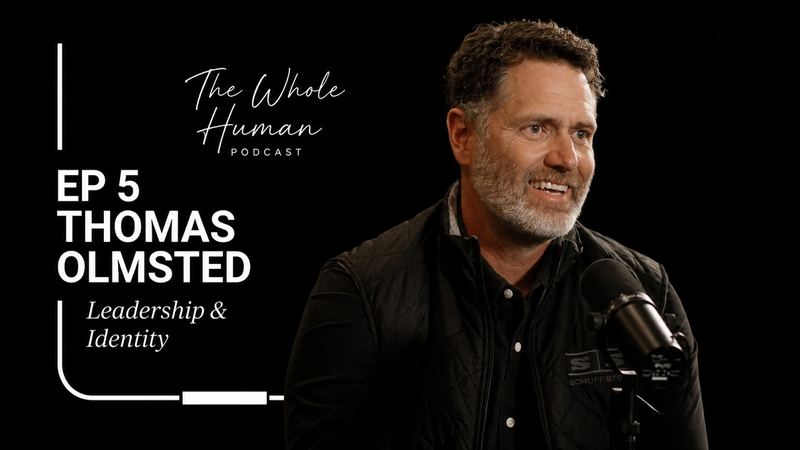
In this episode
Andy sits down with Thomas Olmsted — a small-town kid who played college football and baseball, had a short stint in the NFL, served nine and a half years as a Navy SEAL, went to Harvard Business School, and now works for a large construction company headquartered in Phoenix — and who says the biggest piece of who he is is being a father of three and a husband. They talk about what the SEAL teams taught him about mentorship and mastering the process, why his intensity failed him the first time he led a sales team, and what it means to be the mountain his kids can rest on. Then Thomas gets honest about the hard transition out of the military, when his existence was attached to a title, and the moment he started defining himself as Cannon’s dad instead.
Key takeaways
- Achievement is a treadmill, not a foundation. Thomas spent most of his life attached to the next accomplishment — all-American, Navy SEAL, Harvard Business School — and found that a worth tied to performance never holds. When the title was all he had, the transition out nearly took him under.
- “You confuse accomplishment with loving yourself.” The team wins, the leader loses; the easiest person for a high performer to criticize is himself. Thomas names his inability to appreciate what he brought to the table as the biggest limiting factor on his success.
- Fall in love with the process, not the win. From opening a door a million times in the SEAL teams to building a lineup for a youth baseball tournament: mastering the details is the entry point to being world class at anything.
- “My way is not the right way. It’s just my way.” Intensity that works in operations breaks down in relationships. Meet people where they are, align on the goal, and let the path be fluid — like a sled-dog driver who gives inputs and lets the dogs run.
- Be the mountain. Thomas can’t be with his older boys every day, so he drew what “rock” really means: hard parts and soft parts, a stream and trees, always there to rest on. Consistency is presence, not proximity.
- Fences make kids brave. Andy’s story of children who ventured further in a field with a fence around it; Thomas’s line that to be unclear is to be unkind. Discipline and clear rules are what free kids to be creative.
- Love is the strongest word a warrior can use. Compassion and kindness were hard words for a lifelong fighter, but love builds the ecosystem people actually follow. Andy adds that love for others flows out of self-compassion first — and kids watch how their parents treat themselves.
- “One of the biggest wins is becoming an adult that the younger version of you would want to spend time with.” The shift from “Navy SEAL” to “Cannon’s dad” is the shift from title to being — and the feeling Andy calls being at home: I’m enough today.
Chapters
Transcript
Auto-generated from the episode and lightly edited. Timestamps mark the start of each section; a new line marks a change of speaker.
00:00
“If you attach yourself to achievement, you’re going to be chasing shit forever.” “It’s so easy to feel like we’re not meeting the standard, or we’re not enough.” “My way is not the right way. It’s just my way.” “The moment that I stopped defining myself as this human that has accomplishments and started defining myself as, oh, dude, I’m Cannon’s dad, or I’m Porter’s dad, or I’m Remington’s dad.” “One of the biggest wins is becoming an adult that the younger version of you would want to spend time with.” “If your worth is tied to your performance, you’re in a shitstorm coming up here very quickly.” “I think you said something interesting. You used a word that I think needs to be reiterated.”
Give me just, like, a quick ChatGPT summary. If I were to type your name into Google or ChatGPT and say, give me an auto-response summary of who you are, what would you say?
I’ve actually done that with ChatGPT, and it’s pretty interesting what it pulls out. But, no. So, background: college football, college baseball player, grew up in a small town. I was blessed enough to leverage sports to get out of that town, and then went and played those sports. Ended up having a football career after college as well, where I played in the NFL for a very short period of time. The NFL stands for “not for long,” and I am living proof of that. And then I made a decision right after the NFL that it was time for me to go do something else. 9/11 had a huge impact on my life, and so I decided to join the military. From the military, I didn’t know which exact path I wanted to go down. I ended up going down the path of Navy SEAL. So I was a Navy SEAL for nine and a half, ten years of active duty, eleven total years with my reserve duty incorporated inside of that. And then after that I went to business school — blessed enough to go to Harvard Business School. And now I work in construction for a company called DVM Global. That’s a very large multi-discipline, multi-faceted construction company that’s headquartered here in Phoenix, but we do work all over the world. So in that shell, that’s kind of who I am. I guess the biggest piece is I’m a father of three, and I’m a husband to my amazing wife, who tolerates me, puts up with me, drives me, keeps me focused, and does all the hard work behind the scenes to make all this work.
02:27
How long have you two been together?
So I have two paths with that. My wife — about seven — no, it would be five years now. I’ve been together with her for about seven years. And then before that, I had another marriage, where I had two amazing kids. And, you know, huge blessing. You never know what comes out of things like that, and my sons have been amazing. But my current wife now, five years of marriage, and it only gets better.
One thing I don’t know a ton about, because we haven’t talked too much about it, is for you as a Navy SEAL, and then special operations, what were some of the best things you learned from that about how to show up as a leader, as a father, as a husband? And then what are some things from that ten-year stint that you tried to translate over to leadership and family, and it didn’t work very well? Because I know that that happens at times.
A hundred percent. You know, I think that when I look back at my career, one, I was blessed to be around just amazing leaders. People that were leaders of men, people that created accountability and structure, and they quieted the chaos and created a lot of calm out of that. When you think about the job set of a Navy SEAL, it’s to go into really complicated, challenging scenarios and execute at an incredibly high level, right? And ensuring that the lowest common denominator and the highest common denominator within the group of people are working together seamlessly and flawlessly to execute.
03:52
And the leaders that I was around in that organization, the really, really good ones, the ones that really owned it — they taught us how to lead through that chaos. And I think the biggest thing I walked away with and understand is that mentorship is key. It’s not leadership in that world, it’s mentorship. Are they willing to jump in the stack and actually clear a house with you and teach you and educate you? Are they willing to let you fail with the safety net? I think that’s really, really important: great leaders allow you to fail throughout the process, but they also catch you before you smash into the ground, right? And then they reset you and do it again. And they allow that to happen because that’s when the magic really takes flight and allows you to become great at whatever it is you’re trying to do. That mentorship is vital to successful leadership. The other piece to it is the all-in component. Most of the great leaders that I knew in the SEAL teams were all in to the SEAL teams. Now, that doesn’t mean that they were good in their family lives, but that means that they were all in to what they did. They were dedicated to the details. They mastered the craft. They never fell in love with the results; they fell in love with the process. The biggest story I always talk through with that is, how many times do you think I’ve opened up one door?
It’s probably a million times, right? And the reality is, you need to open that door a million times, because you need to know the hinges, the locking mechanism — is there a knob on it? Is it a push door or a pull door? What’s the offset, so I know where to stand and how I’m going to make entry into that room? People don’t think about that, but these great leaders were able to say, hey, master that process, because that’s the start to this. That’s the entry point to becoming great, world class, at what you do. And so those are the big takeaways when I looked at the leaders that I really wanted to be like in the military or in the SEAL teams. And then when I think about that from a family perspective, what carried over from that — I think a lot of it comes into mentoring my kids, or being that person that is the rock that they can rely on. There may be challenges with marriages or whatever it may be, but my kids understand that I can be that first call, right? And I’m going to jump in the stack and roll up my sleeves and be like, hey, this is what it looks like, good, bad, and ugly. And I’m going to allow you to make decisions at your level of decision-making. But I’m also going to pull you back and be like, okay, now it’s time for Dad to step in and make a decision at my level of decision-making. That type of leader I learned in the military, and I pulled that through, and I think it has really helped me a lot.
06:25
You know, as I think about the people I lead in my business and the organization we’re part of, I think a lot of that is the desire for others to succeed and take my place in the journey that they’re on. So if they want to be head of sales or revenues, how do I train them to take my job, right? So that then I can go do bigger things and they can step up and grow. And that sort of mindset is really a mindset that I’ve pulled through from all the great people I was around — the leave-it-better-than-you-found-it kind of concepts — but then also continuing to grow by pulling the people up underneath you.
One thing that stands out to me is you were surrounded by these amazingly phenomenal leaders that you looked up to, that you observed, that you watched. And I do feel like that is something that has become really important for me — to look at who I surround myself with as an influence on who I want to become and how I’m going to be shaped. And I don’t know if it’s just me, but I feel like as time goes on, there are fewer and fewer communities and people where I look at their life and I admire it and I want to be like them. It feels like those types of individuals are few and far between. And how do we, as a community and as leaders, set that precedent, and maybe be one of those people? Because they’re hard to find. I mean, I work with a lot of amazing leaders, but the type of person that I want to be — I’ve had to get really tight around who I give my energy to, because that’s who’s going to shape who I am.
07:46
I mean, you can’t ask me that question, because I’ve said this before: I hate community so much. I really just like my tiny, small group of people. So I want to toss that to you, because I’m not one to talk about community.
You know, I think it’s interesting to bring the community aspect to it, because there are people within our neighborhoods that you’re just identifying as, oh, that’s the guy who coaches baseball, or he’s the leader of whatever that component is. And I think the biggest portion of that is finding where you fit into the community, and then defining what community means to you. And I remember working with you on this and having a lot of really good conversations about your tribe, right? What does your tribe stand for? What does your tribe do to represent your tribe? Are they out doing things that I don’t agree with as a human? Or are they building better people around them? Are they building the community to be better? I think taking a pause and defining all of that, and then surrounding yourself with that, to your point, but then committing to it and locking arms with it and creating the mission to go improve upon, is incredibly important. And I think the stronger the community, the better off you are. It can be big, it can be small, it can be tough, it can be fragile. But at the end of the day, the bigger, more intricate, more related that community is, the better off it is. And it takes all kinds. In the teams we had dudes that were accountants before they joined, we had guys that were NFL football players before they joined, we had 18-year-old kids that joined. And they all came together and they bought into a mission, and they bought into a mindset, and they bought into an ecosystem and culture that said, hey, I’m going to be this guy, and I’m going to stand on the shoulders of giants, and I’m going to remember those before me, but I’m also going to be the next in line, right? And I think that those kinds of thought processes apply anywhere: community, work culture, military culture, baseball team, football team, soccer, whatever sporting team you have.
10:11
And I think it starts at ten years old or younger. I challenge my kid and say, hey, you’re this all-star baseball player — my son’s a really good baseball player — what does that mean for your community? Are you representing the name on your chest in the appropriate manner? And then all of a sudden you foster that through somebody over time. And then when he’s 42, which is my age, he’ll be like, hey, I’m from Arcadia, and this is what we do, and this is how we handle business, and I’m standing on the shoulders of whatever giants were before me inside of that.
When you say team and you correlate it to community, are you saying that in a community, each person is like a role on a team? Like in basketball, there’s a point guard, there’s a forward, there’s a center. It’s not like everybody’s a point guard. It’s not like everybody’s a forward. Is that how you think about community?
I think so, right? Not everybody can be the point guard, to your point. Not everybody can be the leader of that community, but everybody has a role in shaping and forming that community, and honestly protecting that community. I think at the end of the day, our jobs as leaders, and our jobs as father figures and men within the organizations we’re in, is to protect it, right? There are things you need to let into it and there are things you don’t. There’s good and there’s bad, and our job is to ensure that, as men, we lock arms and protect the ones that we’re supposed to protect and create the culture — create the culture that allows it to grow. We plant that seed, or whatever it is, and it grows and it fosters and it becomes better and more beautiful. And sometimes that’s through war, and sometimes that’s through word, and sometimes that’s through example.
11:26
Yeah. Having a mission or vision, though, has required — or at least I have had to slow down enough to ask the question — where am I personally headed in life? And I have to have a long enough perspective, whether it’s two years, five years, ten years, both around who I want to be as a person and where I want my life to go. I’m a strong believer that there are two categories of people in the future, with AI and everything that’s happening. There are the consumers and the critics. Those are on one side, and they have no power to transform and shape the future ahead. But then there are the connectors, the curators, the creators, and the cornerstones. There are these four types that are about building, bringing people together, creating something, curating — getting all the mess out and bringing the best of the best — or cornerstones, who stand on their values, their ethics, their standards. Those are the people that are going to shape the future. And that’s the side that I really want to be on — not just sitting over here consuming things and critiquing all the things that are wrong. And I think that’s a type of mindset, a type of person. I take that same mindset into myself professionally as an entrepreneur, myself as a father, myself as a husband, myself in my fitness. And I do think there are skills to learn around that, but I do think that’s a type of person. You can’t teach someone that. That’s something that you possess. And I’m curious for both of you: what gets you to perform at your peak? Why do you do it? Is it your activity? Is it passion? Is it purpose? Is it because it’s fun? Because for me, I want to live a fulfilling, purposeful life. That’s what drives me. But what is it for you that drives you to be great, and for you as well?
12:46
It’s very similar for me. It’s very purpose driven. And I feel like if I can’t see — well, okay, let me back up a little. So my wife makes fun of me for this. And my kids make fun of me for it too. They’re like, everything has to have this deep meaning. I went for a run yesterday and the sunset was beautiful. And instead of achieving my five-mile run, I just stopped and watched the sunset for 20 minutes. And to me, that was more meaningful than just doing a run that I do all the time. And so I find that if I don’t see the meaning or the purpose in it, it just really sucks the joy, the motivation out of it. And I’m trying really hard to work on it, and trying to pivot, like, okay, this may not have direct meaning — this is going to change my life, or this is this beautiful thing in the moment, or blah, blah, blah — and trying to pivot it as, okay, well, this is providing for my family. Some things have to get done because they lead to the purpose that gets me there. So for me, it’s very purpose driven, on why I do really anything.
And I mean, with purpose, obviously, you’ve got to understand the why behind it all. It drives me, but I think mine is a little bit different than that. It’s really just — I want to do hard things. I want to be driven to do hard things. I want to be driven to elevate and to be more, right? And I think at the end of the day, you kind of choose these paths, and the framework of my background — I think I failed a lot in a lot of what I did. But I was willing to jump in the arena and do really hard things. And that motivated me to continue to want to do more hard things. And I think now, in the job I’m in right now, it’s how can I learn more so I can do more, and absorb more to do more hard things, and continue that path. And I teach my kids all the time: don’t fall in love with the goal. When we first met, I was like, I just want to win. And you were like, well, let’s dig into what that really means. And winning is so fun, whatever that may be. But the reality is, I didn’t love the win. I love the process. And you just so happen to win as a result of that, right? And then you win some more. And then the process just gets longer and bigger.
15:20
We have a motto in our family. I’ll ask my boys, everything good and beautiful in life is on the other side of what? And they’ll say, hard work. And that is the future as well. Everything’s going to be a lot more comfortable, a lot easier, a lot more simple to some degree. Your life can be a life of consumption in the future if you wanted it to be. Hard work is the thing you opt into. But there is no growth without hard work. There is no growth without pain. So I’ve really learned that part of that growth process is that pain is not something to escape. Pain is something to welcome, because I know that it’s going to make me better. Now, with that mindset, you being such a high performer and wanting to drive, drive, drive, drive, drive and be better — how does that sometimes break down in relationships? Because I know it works really well in operations. I know it works really well in systematic business. But relationally, how does that start to break down?
Yeah, I was talking to somebody the other day about this. One of the biggest challenges that I’ve faced with being someone who wants to always do hard things, or living in the suck and being really okay with that, is that my level of intensity and my level of expectation is out of this world. So when I walk into a room, I tend to walk into a room like — somebody’s like, here we go. I’m here, what’s up? And I think that meeting people where they are is so important, because you asked the question earlier about the challenge I learned getting out of the teams. In the sales teams, I walked into the first room and I was knife-handing people, and I was like, this is how it’s done, and you must do this, and dot, dot, dot, x, y, z — and people were crying. They wanted to fight me. They hated me. And as a leader, I was failing miserably, because my intensity was misguided, and I wasn’t meeting people where they were to then say, okay, how can I help you build this path?
17:51
How can I elevate your mindset to get to where we need to go? How do I bring you into the team so you don’t feel alone and afraid? Meeting those people where they are, and then using my tools — intense, or process driven, or goal driven, whatever it may be — to help them define how they get there, and then watching them prosper and clearing some roadblocks, but also pushing them and pulling them and locking arms. I think that’s really where you take those qualities and employ them into other people to bring them up. And I think meeting people where they are, and not just being an angry person for no reason, or driven for no reason, or must-happen-at-all-costs kind of concepts — you’ll get there, I promise, but you’ve got to do it in a manner that uplifts, and not a manner that destroys.
Yeah, I think about your personality, how you describe your own purpose, and how you describe purpose. And it’s almost like a perfect pairing. If you two could find ways to partner up with people who could match your intensity — you have this high purpose but want to get better at some of those drivers, and you’re that high driver but want to continue to find that purpose.
And I have learned that my way is not the right way. It’s just my way.
Right. A way.
19:06
Multiple ways. It’s a way, and it’s the way that works for me. I get into a lot of trouble in my marriage and with my kids when I start projecting on them: this is not just a way, this is the right way to do it. So I try to align around vision, and then the way in which someone gets there, I try to be a little bit more flexible with.
Yeah. My wife says something — she’s incredibly talented — she always says the goal is rigid; the path by which you get there is fluid. And it’s one of those deals for me. I always think of leadership as being the sled-dog driver, like the Iditarod driver. You put the lead guy in the front because he’s the fastest, you put the middle guys in there because they’re the most steady and stable, and you put the rear guys in there because they’re the force that drives and moves. And all you’re doing is creating inputs. You let those dogs run as fast as they possibly can. And your job is just to give those appropriate inputs here and there, because you know where you’re going, you understand the path, but you’ve got to let those dogs do exactly what they’re there to do — and that’s drive the way they drive and run the way they run. So I think about that all the time when my wife says the path is fluid. If you jump in and say, if you don’t do it this way, and mandate these things, then you’re wrong — at the end of the day, you’re just going to be wrong all the time. So I love what you just said there, and I think about that a lot.
20:19
A quick break from our sponsors. As technology accelerates and AI reshapes the world we live in, we’re being pushed to answer deeper questions than ever before. What is our purpose? How do we stay truly connected? And how do we build families and legacies that don’t just survive but actually flourish? I created Pursue Whole to help leaders and their families pursue lives of purpose, meaning, connection, and impact. At Pursue Whole, we are on a mission to build transformational brands, products, and experiences that help leaders, couples, and families stay aligned, feel deeply connected, and live with purpose, on purpose. Because success in one area of life is not enough. We exist to help you pursue wholeness in every aspect of your life and leadership. The future isn’t just reshaping how we work; it’s reshaping how we connect, how we lead, and how we make sense of who we are and our purpose in this world. And without intention, it’s easy to drift — accumulating success on the outside while slowly losing what matters most on the inside. Pursue Whole exists to help you stay grounded, connected, and fully human, so you can build a life, a family, and a legacy that truly lasts. And back to the episode.
21:35
Now, one thing that you said in the beginning that I feel is such a huge part of whether it’s work, marriage, or being a father, is you mentioned that you want to always be that rock. And in order to be that rock, it involves consistency. Otherwise, you can’t be this thing that they can keep coming back to. I was actually talking to my wife about this a couple days ago. I don’t know if you’ve ever watched the show Full House, or shows like that from the ’90s. You have Danny Tanner or Uncle Jesse or Uncle Joey, and every single episode, around the 20-minute mark, they have this serious, meaningful conversation with DJ or — I can’t remember the other girls’ names. Michelle, yeah. The music would start playing and they’d have this really meaningful conversation every episode.
And then I was looking at my own life. I have four kids, and they’re all in these different stages of life. My daughter’s almost 13. My boys are 10, 9, and 7. And I find that every single week, I’m having these Danny Tanner conversations with them. But then I’m not seeing the fruits of my labor. I’m not seeing what I’m saying fully resonating with them. And my wife is really great. She just reminds me constantly, whenever I’m like, I just told them not to do this, right? I gave them this really great talk, and then one of my boys is shoving the other’s face in the sand, and I’m like, come on, man, we just talked about this, and it was really beautiful. But my wife’s always good about reminding me: they may not remember the conversations. They may not hold on to everything you say. But they’re going to remember that you always showed up, and you were always having those conversations, and you were consistent with it. And so for me, I’m trying to remind myself — I know my intention is good with what I’m saying, but I need to remember the most important thing is I’m showing up for them. And I’d love to hear from you. You are striving to continue to be this rock for your marriage, for your kids, for your work. I’d love to hear from you a little bit of what that looks like.
24:06
You know, I use the word rock, but again, in talking with Andy over the past couple of months, he had me visualize and draw out what my thought process was, and what image I’d created of myself. And I think it’s unique, because I’m in this divorce situation where I’m this father who can’t be there 24/7. I have to pick and choose and understand what that looks like, and create the boundaries around whatever that is. And then I’m a father full-time to another kid. And so I really sat down and I was like, rock — what does that mean? And I actually drew the picture of a mountain, and I’ve got a stream running through it, and trees growing on it. And there were hard parts, there were soft parts, there were big parts and small parts. But at the end of the day, it was a mountain that was always there, and the visual was always there. When you get tired, you can sit on the mountain. You can rest on the mountain. You can grow your trees on a mountain. You can get water from that mountain. And so when I think about the consistency of it all: I can’t always be the way I want to be with my two oldest boys, almost 13 and 10, where I’m there every day and I’m that driver. But I know without a doubt that if it ever got to a point where they needed to rest, or there’s a challenge, or they needed whatever it is, I’m the mountain that they’re going to rest on.
And that consistency can be through a text message or a phone call. I’m a big one-liner person. I have a million one-liners — you could ask my older son’s baseball team, I’m full of one-liners. And so to me, they may not remember the moment or everything, but I say these one-liners so much that when I die, I promise you, they’re going to remember these one-liners. And that becomes the mountain that they have to lean on. So consistency — I think it’s the right word there, but it’s also understanding that there’s a time and a place to father, there’s a time and a place to mentor, there’s a time and a place to friend, right? There’s a time and a place to do nothing. And I think understanding how that mountain looks, to me, with my kids, is really, really important, because it may not be consistent to everybody else’s view, but I’m always there. And I think that’s so important — that they just know that, and they feel that. And I hammer, but I’m also silent. And I think giving them that space to go operate is vital.
26:33
I think that’s a beautiful analogy. And I go between these two states, because I have three boys, and I’m one of four boys, and my father’s one of four boys — really five, but he lost his youngest brother. So there are all these men in our family, and I’m having to conceptualize: what does it mean to be a man? What does it mean to be masculine? What does it mean to be a leader? And I’ve had to really figure that out on my own. And with my 11-year-old, Achilles, I really try to shape and coach him. And sometimes I feel like I’m too hard on him. I had a conversation with him the other day, and I just sat down with him and tried to explain. I said, Achilles, do you know why sometimes I push you so hard? And he’s like, no, I don’t know. And I just shared a little bit of my story — my relationship with my dad, and some gaps that I had with my dad, where I would have wanted my dad to step in more, to coach me more, to guide me more. And I felt like I had to do life on my own. These are things I’ve had conversations with my father about, and these are conversations I’ve had with my son about. And it was really good, because I let him know. I said, son, Grandpa has gaps. He’s an amazing grandpa. There are so many amazing things he did, but there are some gaps that he has. And guess what? When you grow up, there are gaps that I’m going to have as a father — some things I gave you and some things I didn’t. But I want you to understand that my intention to push you and drive you is out of love, because I never want you to be ill-equipped for the world ahead.
I want you to be able to rely on me. And I thought that he was going to communicate to me and be like, well, you’re really too hard on me. And he just turns to me and says, I like when you push me. And I was like, oh my gosh, you’ve got to be kidding me, because I feel like you blow up at me, or I blow up at you, and I push you too hard. But he’s like, no, I like when you push me. And I said, well, why is that? And he said, because I feel like it challenges me to do things harder and better than I would have done on my own. And I’m like, that’s a beautiful thing as a father. But that balance can be broken so fast, because sometimes he needs the gentleness and the tenderness. Sometimes he needs that push. And I think for the rest of my life as a father to boys, I’m going to be learning the delicate balance between the push and the comfort — the hug and the push. But I just thought that was beautiful, because like you were sharing with your kids, sometimes we get those windows where our kids affirm that we’re doing something right. And it’s just this beautiful moment where I’m like, okay, that was significant right there.
27:53
Yeah. And I have some similar things with my kids too, where my daughter will be on her phone too much, or my boys will be on their computer too much. And “too much” means something different to everybody. It definitely means something different to me than it does to my wife. I think five minutes is too much. But I notice that when I bring in some of that structure and pull things back a little bit for them, they actually really like that that’s happening. Instead of just letting them do it — yeah, you can have a limited time with this, or whatever — they tend to be like, no, Dad, I like when you set some boundaries. And I think —
They’ll deny it, but deep inside, it’s such an important thing, I think, for sons and kids: to be shaped. There’s a story — when I was doing therapy, my therapist told me once about this study where they had all these kids in a field, and they wanted to see how far the kids would venture out into the field. And they only went so far, maybe 50 feet, 100 feet. But then they put them in a new field, and that field went really far, but it had a fence around it. And they found that the kids ventured out and went all the way out to the fence line. And it shows that when there are no boundaries, when there are no expectations, when there’s not clear communication, when kids don’t know what they’re going to get, it’s scary to them. They don’t know how to test the world. But when you give them limits, when you give them direction, when you give them standards, they can go all the way to the end, because it feels safe. They know what’s expected and what’s not expected. And that was a good reminder to me: having a relationship with my kid just as a friend is not going to suffice. I have to guide and shape and direct it.
30:20
There’s that whole saying: discipline is freeing. And I think to be world class at anything, you have to have discipline. To be a world-class father, a world-class husband, a world-class worker, or whatever it is, that discipline has to be there, and that structure has to be there. In the SEAL teams, we used to talk about it all the time. We had the discipline to do things very, very specifically — how we moved into a house, how you do CQB, close-quarters combat. And the reason we had that discipline is so that I knew what rules were out there, and what rules I could break. And if I broke those rules, how did I communicate breaking those rules so I could get support to help me out? And I think a lot of that applies to being a kid, or a father: let me give you the rules to this game. To be unclear is to be unkind. So it’s unfair for me to have expectations of you if I don’t have clear rules around what I want you to do. And I think that’s so important — to create that structure. Not everyone will agree with me, but I think it’s very important. And I think that discipline and that structure, and defining the rules and the expectations and clarity, actually allow people — the kids — to be creative. Because then they’re like, okay, well, Dad’s expectations are x, y, and z. How do I get there? What do I do? Let me go think through this problem and solve these problems at a certain level. And I think that’s really, really important.
One thing you said — I don’t know why this made me think of this — I have a motto in my house, a motto with all my kids, and people can judge me if they want, it’s okay: be a hard man to kill. Be a hard man to kill, whatever you do. If you show up to a baseball game, be prepared for it. Know the rules to it, understand the circumstances and situations within it. If you’re at school, study, pass the class, accelerate. Don’t just be there. Don’t just sit there and take on whatever’s being done. Be a hard person to kill, because society right now, I think, with the presence of AI and the presence of the technologies that are out there — our kids specifically are becoming incredibly vulnerable, because they’re growing up faster with fewer rules. And I think that that’s a recipe for a major disaster. Zero privacy — pictures they take now are there forever, but they don’t know the rules of all of this, and they get trapped in these weird situations with people that could be bad actors or not. And they just don’t know how to navigate. So put yourself in a position to always be a really hard person to kill, whether that’s owning your craft, or knowing the rules, or creating the boundaries and building the discipline and structure, because the way the world works today, you will get run over, and you will consistently be behind, if you just mimic what society is accepting right now.
32:51
I wonder what you would actually say to that, if you had a motto like that.
I think for me, my motto in a way would almost be: be the type of person that always gets back up. That mentality. Maybe it’s not be a hard person to kill, but be the person who won’t stay knocked down.
No doubt.
So it’s this level of resilience, this level of drive, and be the person who adds a tremendous amount of value and love into people’s lives — that you give of yourself in order to help others flourish. That would be my motto. What would be yours?
I mean, it’s all similar. Mine is not so much — I love “be the person that’s hard to kill,” because that works on so many levels, and emotionally that works really well, where you’re able to withstand certain things and not let emotions control you. But for me, I think mine is more this idea of just be the one to keep going, keep moving forward. And it’s almost the same meaning. I could create a film and have it fail and then just be like, well, I’m done. But that’s not moving forward. That’s not keep going. That’s not learning from my mistakes or learning from my failures. So for me, it’s less about don’t be somebody that’s hard to kill; it’s more just get up and keep moving.
34:05
Yeah. I think you said something interesting. You used a word that I think needs to be reiterated, and it’s the word love. I think people confuse sometimes, like, being this tough Navy SEAL — I’m hard as nails and all that sort of stuff. And when it all boils down to whatever it is, the word love matters. Love what you do, love the people you’re around, love the process, whatever it is — fall in love with the process. That word love is probably more powerful than anger or hate or whatever the other words would be there. And I think that showing that love creates the atmosphere, the ecosystem, around compassion and kindness — words that I’ve had a really hard time with my whole life, because I’m a fighter, and that’s just innately who I am as a person. But looking at it from the lens of love is vital. And I learned this a long time ago. There was a guy, I read his book, and he was somebody that I thought was really, really important in the SEAL community. His name was Adam Brown, and he passed away a handful of years ago, but his whole thesis was to lead as you love, to lead as you bleed, right? And to be there with the people, and not be angry or upset. There are stories about him doing some amazing things around being compassionate and humble, and not just angry and a fighter and a warrior. I think warrior takes on a shape, but that word love is what really, in my opinion, drives home the people that we all could be. Because if we could love one another, I think you would eliminate a lot of the noise, and you would have real dialogue, and so on.
36:40
So one of my favorite movies is Interstellar, and there’s this line in it. Anne Hathaway is talking to Matthew McConaughey, and they’re deciding which planet to go to next. I don’t know if you’ve seen the movie or not, but there are these different astronauts on different planets, and they have to decide: they can pick this planet or this planet. And this planet happens to be a person that Anne Hathaway is in love with. And so Matthew McConaughey is just like, nope, you have a biased mindset to it. Then she delivers this thing, and she talks about how special love is — and it’s not just romantic love, it’s love in general. And Matthew McConaughey is like, well, love helps us reproduce. He’s very scientific about it. So he’s like, that’s one thing. And she’s like, yeah, but you can love something that’s dead, as in a grandmother, or somebody that passes away. There’s no survival skill in loving something that’s not here anymore. And then it goes into this other thing of, we look at our universe, and what we can see — granted, we can’t see that much; we can see far, but we still are barely seeing into stuff — and we’re just not really finding consciousness, or what we deem as consciousness. We’re not really finding love, happiness, anger. So this idea of love is something that we’re finding to be very rare and incredibly special. And it’s something that we all get to experience and have, and it’s something that we should really be acknowledging — the fact that this is such a rare, beautiful thing that we can pour into so many aspects of our life.
37:53
To me, love is a response to having love inside of us already. So the biggest thing that I’ve had to learn in my life over the last 15 years is self-compassion, because I can be very loving to others. I can show a lot of care. But when I make a mistake, and when I hurt somebody, the way that I talk to myself and treat myself is at a standard so much higher than the standard that I would put on others. So I’ve really had to learn how to receive love. For me, it’s from God, and for me, it’s from letting my wife in, and letting my kids in, and letting my friends in to love me. And when I do that well — when I have a healthy sense of self-love, where I can look at myself in the mirror, not out of ego, but out of self-compassion, and forgive myself, love myself, enjoy who I am and who God built me to be — to me, that flows out from me onto others. And you can give love, but if you don’t have self-compassion or self-love, your kids are going to pick up on it really quick, because kids don’t listen to what we say; they watch how we respond. So we might say, love others, love others, but they’re going to watch very quickly and see how well their fathers and mothers love themselves. Do we take care of ourselves? Do we treat ourselves well? Do we speak well of ourselves? So I think that’s a really important thing for leaders listening: if you want to be loving, you have to do the deeper work to ask yourself, what parts of you do you feel are hard to love? The mistakes you’ve made, the vices you have, the ways you’ve hurt others, the parts that aren’t as strong but are more scared, more depressed, more anxious — you have to look at those parts and learn how to accept, love, forgive, and welcome those parts. And if you can’t do that, you’re going to be a very fragmented, disconnected person. It’s one of the most important things I’ve learned, and that I try to teach leaders about.
39:15
I think it’s the hardest piece to it all. When you’re a high-performing person, the easiest person to criticize is yourself, right? Because regardless of what happens in the scenario, I always think about it like: the team wins, the leader loses. So I’m the leader, so I’m the loser, right? And you get crushed in that mindset. And it’s been something where you think, oh, a high-performing person, someone who’s accomplished so much — you confuse accomplishment with loving yourself. You can’t hide behind it. You either do or you don’t. And I think that in working with you and talking a lot with you over the past couple of months, I recognized that I didn’t love myself at all. And I think the biggest limiting factor to my success was my inability to appreciate what I brought to the table. It creates the imposter syndrome, or it creates the — I used to talk about it: I didn’t know if I should wear Jordans or if I should wear cowboy boots. I didn’t have a clue who I was. That lack of identity stemmed from the inability to understand who I was.
Well, you were probably also taught, as a silent professional, to not focus energy toward yourself — make sure it’s poured out on others. Was that something?
Yeah, I mean, we used to say suffer in silence, right? Suffer in silence. No one needs to hear you suffer. And there are moments where that makes sense, I get it. Like when it’s really, really hard on your team, and maybe we should recalculate that. However, when that becomes the philosophy or mindset — to suffer in silence through everything — when sometimes the communication and the conversation allows you to heal faster, or to forgive quicker, or to be more present. Those challenges become — you’ve got to do the hard work, right, to get over that. And honestly, for 32 — for basically all my life, I’ve been attached to achievement. I’ve been attached to what’s next. I’ve got to do something bigger. I’ve got to make the front page of the newspaper. I’ve got to be an all-American. I’ve got to go be a Navy SEAL. I’ve got to go to Harvard Business School. If you attach yourself to achievement, you’re going to be chasing shit forever. You’re just going to be on this journey toward something — whatever that dopamine hit is. But if you pull yourself back in and you go, okay, why am I doing all this? What is fulfilling my heart? What are the things that I’m most excited about?
42:51
When I look in the mirror, do I see a slug, or do I see a winner? I think you have to start really doing that sort of work, because the next iteration of leader in our community and our society is not going to be the loud, microphone-toting, I-make-$100-million-a-year, crack-the-whip, bust-your-head kind of person. The next evolution of leader is going to be the leader that locks on with you and carries you, and you carry them, and they understand who you are as a person — not just who you are as an employee or a number. And you can’t do that unless you’ve talked about who you are as a person, because if you show up like crap, people don’t want to follow you through, right? I think that inner love is so important, and surrounding yourself with a tribe, or people that maybe have shared experience, maybe don’t, but they recognize the greatness and they’re not going to hammer you for mistakes or hammer you for missteps. They’re going to say, hey, dude, got it — how can I help? That’s what men need in our society. Being a man right now is a really hard place to be. And I think building those tribes around love and compassion and understanding and character building and growth — and not alcohol and stupid stuff that gets you in trouble — but the real, meaningful conversations.
I’m not tied to work specifically, because if you look at the progression of work over the last 800 years, it’s changed dramatically. Work did not become a source of identity until the 1990s, 2000s, where it started to be integrated — what I do is who I am. And that’s very problematic for what you’re talking about. If your worth is tied to your performance, you’re in a shitstorm coming up here very quickly, because the speed at which you do things, how smart you are, how efficient you are, how effective you are — it’s all going to be replaced. AI, robotics, and all those things are going to be way smarter than you, way better than you, probably a better CEO than you, probably a better leader than you, probably better with people than you. So you have to go to a deeper level and say, okay, my worth and value have been tied to what I do, how I perform, and my title. All that’s going to get stripped away, and you’ve got to go to something deeper. And we’ve got to teach our kids about something deeper — and it’s about creativity, it’s about passion, it’s about curiosity, it’s about love, it’s about purpose, and getting back to those core foundations around our values, our ethics, our purpose. I think that is the future of leadership, honestly, because if you’re placing leadership on performance and execution, you’re going to get washed out. It’s not going to matter. So co-creating with others, and being someone that’s likable enough, kind enough, loving enough, value-driven enough that people want to partner with — that’s going to be the future of leadership.
45:34
I love, though, that you talked about chasing achievements, because last year I turned 40, and people would constantly ask, reflect on your life, tell us what the last 40 years have been, man — which is like the dumbest question. And I looked back, and I’ve got some great achievements, but a lot of it was tied to stress, and tied to long hours working. And then I looked back and I was like, okay, I got this achievement, this achievement, this one — what did it do for me? And really, if I were to take that achievement away, how would it change my life right now? And honestly, it wouldn’t change my life at all. And so I wasn’t filled with regret, but I saw that there was a lot of wasted time on things that brought a lot of stress — even things I don’t remember. I remember the stress, but I don’t remember what I was stressing about.
I think to that point — I mean, how did I introduce myself? I named my achievements. And all of a sudden I was like, oh, wait, wait, I’m a father and I’m a husband, right? That’s probably the cooler thing. It gives you, like, well, this is who I am, this is why you should listen to me. And at the end of the day, that is a reason, but maybe not a good one, because not every Navy SEAL is amazing, and not every Harvard Business graduate is that smart, right? And so I think that chasing achievement, if that’s what defines you, you’re only setting yourself up for failure — and I’m an example of that. When I got out of the military, I had a really, really hard transition out. I went through a lot of complicated mindset. I went through suicidal ideations. I went through, you know, PTSD, I guess, is what people would call that. I don’t know exactly what that means, and I don’t believe in PTSD — I believe in PTS. But that’s another story. And I went through probably a year and a half of really, really, really hard times where I didn’t really want to be here anymore. I thought about what that would look like. Fortunately, my kids kind of brought me out of that. But my existence was attached to my title — Navy SEAL, or NFL, or whatever it was.
48:01
My existence wasn’t attached to my purpose or my being. And I think that, as someone who’s an elite performer, it created this huge disconnect in who I was trying to be, wanted to be, where I needed to be in life, the decisions I was making in life. I didn’t have core values. I didn’t have stability of any type to make decisions, or sound decisions, off of. And I was just looking for something to throw my body onto, to attach to, to either ride the ride, take it over, or ride the ride till I got to a destination to jump off. And whatever that was, I didn’t know. And then the moment — and it took a long time, and I’m still working through that — but the moment that I stopped defining myself as this human that has accomplishments, and started defining myself as, oh, dude, I’m Cannon’s dad, or I’m Porter’s dad, or I’m Remington’s dad, right? Or like, hey, I coach baseball, I love it. That’s the cool stuff. That’s when I started identifying who I actually am as a person. What gets me excited? Building my lineup to go coach a baseball tournament. If I could figure out how to monetize doing stuff like that, man, you would never see me in a suit and tie. I promise that.
I saw this reel, and I was blown away by the depth of it, because it shares a sense of gratitude, and I just have to show it to you. Let me find it here.
49:21
(A reel plays.) “I wonder what my childhood self would think of me today.” “If you take this marker, your childhood self will appear between you.” “Did you just read my mind?” “Just go with it. Do you want to take it?” “When I was a kid, I just had so many big dreams. I wanted to be an astronaut, a rock star, a director. I don’t know if I want him to see my life now.” “Well, there’s only one way to find out.” “Hey, are you grown-up me?” “Yeah. And look, buddy, I just want to say, I’m not an astronaut. I’m not a —” “Is this your apartment?” “Yeah.” “No way, we have our own place!” “We do.” “Do you know how to make grilled cheese?” “No way, that’s awesome. Grilled cheese is pretty awesome, even as an adult.” “Can you drive?” “Yeah.” “No way, you know how to drive! Do you feel like going for a ride?” “Yeah, let’s go for a drive.” “You can eat grilled cheese. Oh, and you can get your own beanbag chairs, and you can eat grilled cheese in them. And you can stay up as late as you want.” “Oh, you should get a sign for your place, like the one that’s on my bedroom door. That’d be pretty cool.” “That’s a great idea.” “You still come play in this park?” “Sometimes, yeah.” “Wow. I can’t wait to grow up. Come on, let’s go.”
51:05
When you look back at yourself as a kid, and you look at your life now — if you had that opportunity where I hand you this device, and instead of you going back in time, it’s the younger version of you, let’s say the eight-year-old version of you, or the ten-year-old version of you, and they get to see grown-up you now — what would they think of you? One of the things that I loved about that reel is I always like to look at the comments, and one of the comments, I’m just like, man, this is a great comment. The comment was, “One of the biggest wins is becoming an adult that the younger version of you would want to spend time with.” Do you feel that way? Are there things that you probably would be nervous for a younger version of you to see? Or do you feel like the younger version would just be blown away, like, oh my gosh, you’re doing this?
Man, that’s a super —
Watching that, do you get a little bit emotional, just thinking about it for you?
Full-on teared up with it. Yeah, it’s an interesting deal, because I never would have imagined at 10 years old, or 8 years old, or whatever, that I’d be even close to where I am right now. My family was what they were, and I had incredibly cool role models in my father and my grandfather — they had gaps, whatever you want to call it, but really cool stuff there. And I always wanted to be a pro athlete, or whatever it was, but never in my wildest dreams would I think I’d live in Phoenix, Arizona, with three amazing kids and an amazing life, and a job where I get to travel the country and build cool stuff, and coaching kids. I think that’s cool. I think my 10-year-old self would be like, dude, you’re doing it. Just keep going. Don’t listen to the bullshit. Don’t listen to the naysayers. You’re living it.
52:24
To me, that’s the feeling of being — I describe that as being at home. Like, I’m home. The sense of, it’s enough. I’m enough today, right?
Yeah.
That feeling — you can’t buy that. You can’t work for that. You’ve just got to come to terms with that. And it’s a beautiful feeling to know that you’re enough where you are today. And it brings, for me, some level of excitement for the future — of wanting to live with more purpose and passion for the future, and just freedom.
Yeah, and we live in this hustle culture, and a life of achievements. And it’s so easy to feel like we’re not meeting the standard, or we’re not enough. But that mentality of what we just watched, and hearing you — it’s like, man, the younger version of me would just be so blown away. Like, I had no idea that this was even capable of happening in my life. And yet here I am, like, oh man, I just didn’t make this video that I wanted to make. He’d just love what I did.
53:35
Yeah, it shows how stupid the things are that we worry about.
A million percent.
It puts it in perspective. I think perspective is so important there. I think at 10 you don’t know what the world really looks like. At 42, you’ve probably seen too much of the world. And the Joneses are real. But you’ve got to go back to love, and understand who you are.
The Whole Human Podcast
Watch this episode — and every episode.
New conversations on staying human and whole in a world that keeps accelerating.