
Library / Podcast
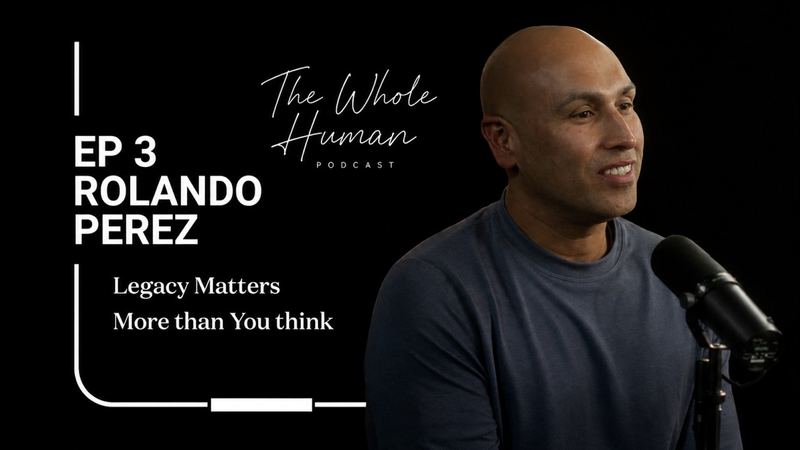
In this episode
Andy and Jay sit down with Rolando Perez, who runs an organization that resurfaces city streets for municipalities — but when people ask what he does, he says, “I build legacies.” Rolando started out doing labor in the field, had a family young, built a business to provide for them, and along the way learned he was giving more of himself to his craft than to his kids. The conversation moves from what a legacy really is and what “holistic wealth” means, to peeling identity apart from work, to how AI is reshaping creativity, connection, and the way we raise children — and ends with what Rolando would say to his eight-year-old self.
Key takeaways
- “I answer it by saying that I like to build legacies.” Rolando’s company resurfaces city streets, but the work he cares about is helping his people become the best version of themselves — something that outlasts him, “generation after generation after generation.”
- Holistic wealth isn’t only financial. To Rolando it’s mind, body, and soul — the systems that let a person be the best version of themselves, and that keep working long after the founder is a picture on a wall.
- Double down on the gift God gave you — and don’t shortcut the journey. AI can help you vet ideas, but “it can’t answer what your heart tells you. It can’t fill that cup for you.” Bumping your head is part of how purpose gets refined.
- What you do is the vehicle; who you are is the driver. Andy traces how work shifted from survival to virtue to identity through the Industrial Revolution — and why those two things now have to be peeled back apart. Rolando’s answer: family first, faith, and being “a great example and a great steward to God and to my children.”
- AI can’t pull from your emotional journey. Give three chatbots the same movie prompt and they draw from the same sources. Your life, your perspective, and your story are the one thing they don’t have access to.
- “Can I communicate this on my own?” People are outsourcing apologies, conflict, and hard conversations to AI. Relational conflict is a rite of passage — the pain and vulnerability attached to relationships are what make them beautiful.
- Processed food vs. whole food. Digital connection is engineered to leave you less satisfied so you consume more; one-on-one connection actually nourishes. Change how we talk about AI with kids: not speed and comfort, but depth and connection.
- Strip everything away and what’s left is relationships. Rolando gave too much of himself to his craft, apologized to his kids, and now leaves space open for connection to grow organically — “teaching my kids to fish” rather than handing them fish.
Chapters
Transcript
Auto-generated from the episode and lightly edited. Timestamps mark the start of each section; a new line marks a change of speaker.
00:00
I answer it by saying that I like to build legacies.
So there’s what we do and there’s who we are, and those started to bleed together. Strip everything down to the bare bones of humanity — I feel like relationships are probably our top purpose in life.
That’s part of what drove me to my growth. I understood that I was giving so much of myself to my craft. I don’t even know if they know what their purpose and drive is. But the thing that people don’t have full access to… We’re so excited to chat with you and really get to know you and hear your perspective on a lot of these topics — whether it’s leadership, artificial intelligence, or just getting down to this deep emotional level of what makes you you. So when I’m asked this question, I hate it so much and I downplay it all the time, and it’s the question of what do you do, or what is your job title? For me, I always say, “I’m a filmmaker,” which is such a blanketed statement, but I’m not going to let you get away with that. So I would love to hear, in your words, what it is that you do — and also why, out of all things in the world, why are you doing this? So that’s a pretty great question. I answer that a little bit differently. I answer it by saying that I like to build legacies. That’s part of what I’m trying to do. And the idea for that is, people say, “Hey, give me more.” And I want to go a little bit deeper, in a sense. So what our organization does is we resurface city streets for municipalities. But more important, what I feel like I’m doing is trying to help our people achieve something great through things that I’ve learned, right?
So how do I share that with them, and how do I help them to be the best version of themselves? So that’s kind of what we do. What our mission statement is, is building legacies through empowered ownership, innovation, and a shared path to a brighter future. So when people say, “What do you do?” I say, “I build legacies,” right? And that’s the way that we do it. In your mind, do legacies last? Do they go from generation to generation? And what is the point? I think it’s really common for a lot of leaders in their families and in their businesses that they want to build a legacy, but what does that mean to you? And how long does that last?
02:47
So hopefully it lasts way, way past me, right? Something that I started can go on way beyond me. That’s what I’m really hoping to achieve, and I’m trying to put systems and things in place and help people to get there, way past me. I started the organization hoping that we could do something greater, and we’re on a mission to try to do that. For me, I’m hoping that it services generation after generation after generation. We look at it more as holistic wealth, right? And holistic wealth to me isn’t only about financials. It’s about mind, body, soul — really just creating the systems to be the best version of yourself. So yeah, that’s kind of what we focus on and what we try to do. But hopefully way, way past me. And there is a little bit of ego and selfishness in that: if I can create something, and maybe my name or a picture of me is on a wall a hundred years from now, or fifty years from now, or more, then that’s pretty awesome — that something we created, and these people that we’ve shared ourselves with, can have turned it into something even more and greater.
Then it’s just a beautiful thing, and that’s part of what I believe — it’s just me trying to serve something that I believe is my purpose. Adding value to the world. With that, one of the questions I’ve been chewing on and very curious about is, with everything that’s changing and moving, and how fast it’s moving, I’m wondering what is actually going to be most important in the future, so that I can focus on those things now. What do you see is going to last over the next 20 to 30 years? And what are you banking on, investing in right now in your lives, that is most important? Well, as we’re being thrown into AI craziness, it just gets better and better and better, and there are a lot of great things with it. The industry that I’m in is relatively scared. But the thing that I think is interesting is, just because AI can do something, that doesn’t mean a client can communicate what they want, or can really articulate the story. Sure, everybody’s a storyteller — your grandma’s a storyteller — but then it’s about whether you can take a message and make it emotionally impactful for a call to action to sell a product. Grandma can’t necessarily do that. That’s where filmmakers like me come in on the commercial side of things, where I feel like technology isn’t really going to be able to take that away.
05:39
Maybe it can help give ideas, maybe it can help share things, but for me, I feel like all this technology and all this shift into AI is really just turbocharging what we can creatively do as storytellers. So over the next 20 years or so, I think for me, in my business, I’m just really leaning into creativity, which is a skill that doesn’t require intelligence. Anybody can be creative. You don’t have to go get a bachelor’s degree in creativity — that doesn’t exist. So anybody can be creative, and I think that’s really our superpower. Whether that’s with what I’m doing in filmmaking or what you’re doing with your job or what you’re doing with your job, creativity is a trait that just carries over into everything that we’re doing. And if you think about it, humans creatively adapt to what’s going on. There used to be the man that would sit in the elevator and press the button to go up, and that job doesn’t exist anymore. So…
The bellboy.
Yeah, the bellman. So we had to creatively think of another job. There were also men in a warehouse that would do the numbers for bank tellers, and now a computer does that. So those people had to creatively think of another job. Creativity is this thing that just keeps going — creativity can be exponential now because of the tools that we have. I struggled for a little bit when these shifts were happening, earlier on in my career, thinking, man, am I really that creative? I don’t do art as much. I’m not creating video like you are. But I took a broader perspective on creativity, defining myself as a creator — someone who wants to put goodness out into the world, and wants to not just sit back and consume, or just see where things are headed, but actually choose to put something out in the world that brings about healing and wholeness and goodness. And that is me creating. That is me taking what I know, taking where I’ve been, and putting it out into the world. To me, what’s really important moving forward — I think the most fundamental thing for human beings moving forward — is our ability to connect with ourselves, our ability to connect with others, and our ability to connect with our sense of purpose and meaning in life.
And I think that is the thing that will go away or get lost over the next couple of years, because — you talked about storytelling. Everybody’s a storyteller, but I don’t know if people know what they want to say. I don’t know if they know what they want to tell the world. I don’t even know if they know what their purpose and drive is. And I know you have talked a lot about that.
08:32
Yeah. Everything you guys are saying, I couldn’t agree more with. For me, it’s first doubling down on the gift that God gave you — that’s how I say it. Figuring that out. And it sounds like you guys obviously found that in your own ways, and you’re putting that to good use in the world and adding value through that. I think that once you start adding value that way, you start to really hone in, and we get to massage that purpose and really understand what that looks like and means. And I think with technology and AI, where it’s going, it could be really beautiful, and it could be a little scary at the same time, because sometimes people are leaning a little bit too much on it to do some of the work for you. I think if you have a good understanding of what it is that you want to accomplish, or if you’re using it to vet what it is that you want to do — trying different things out — that’s one thing. But I still think that we have to go through the actual practice of trying these things, bumping our heads a little bit and feeling that pain of, “No, I don’t like that. No, I do like that,” and getting to that place. That’s where that happens. And I think that we all go through that, right? That’s part of the journey. So I think the future, to me, is still the same. Those same principles stick: we need to double down on understanding what gifts we have and then put those to use. But there’s a journey that happens, and I’m a little concerned with AI that people are trying to take some shortcuts, and those shortcuts are going to hurt us. They don’t really get us to where we want to go. We may not end up where we think we want to be. So those are some concerns. And on the shortcuts — what do you see?
I think people are trying to take tests and rely on it to tell you what it is that you’re supposed to be doing, but it can’t answer what your heart tells you. It can’t fill that cup for you. So those are the things that you have to go through. And to be honest with you, I think about it and I’m like, man, if I didn’t have to go through all the pain, would I have taken a shortcut myself? I’m just fortunate that I didn’t have the technology then, because I don’t have to answer that question. I had to go through the journey that I went through, which was a painful journey, right? The way I say it to people is, I don’t know a lot of what to do. I know a lot of what not to do. I made a lot of errors, and that’s formed me into the person that I am today. But I’m also proud of that. So if I’d had that same technology… Those are some of the shortcuts that I’m a little concerned about, and I’m more concerned for my children. I try to tell them about some of these things. But yeah, I definitely think it’s doubling down on what your God-given gifts are, in a sense, or what your talents are, and then how you start utilizing those to really refine what your purpose is. Because somewhere, those two things cross, is how I feel. Then your heart starts to get filled with what you’re doing, and work feels like it’s worth getting up to go and do. It doesn’t feel miserable, with everything that goes along with that.
11:47
Well, I want to touch on two things. First, you’re talking a lot about purpose, and I want to ask you, with your job — two things. When you were a kid, did you ever imagine that this is what you’d be doing?
Oh, no.
Probably not. It was probably astronaut or actor or superhero or something like that. But what did you want to be when you were a little kid? Then two, after you answer that: what is it with your job now — which maybe took you away from that dream as a kid of being whatever it might be, a firefighter or whatever — that you find fulfillment and purpose in? What is it that happens to you internally that you find fulfillment in what you do with this career that you have? Because a lot of us identify ourselves with our career, which we probably shouldn’t, but a lot of us do. I know I find a lot of identity in my career, and I don’t think that’s necessarily a bad thing, but at some point we’re not going to have that career. But for right now, it’s giving you a lot of fulfillment. It’s giving you a lot of identity. So what is it that happens to you internally with this job where you’re like, this is why I’m doing this? So that’s a pretty deep question. For me, as a child, I just wanted to be successful. We didn’t have much, and you wanted to have something, right? You just wanted to be different. So my idea was just to be able to provide value in some way. I didn’t know exactly what it was that I wanted to do. I knew that I didn’t want to do what I’m doing, in the sense that we started out doing labor, started out in the field, just being dirty and doing nasty, dirty work. And I was like, this is the opposite of what I ever envisioned. This isn’t at all what I wanted to do and be. But through that, I got really good at it, and right away understood that communicating with people was one of the most important key areas to live and focus in. And then we started growing, and started our own business. And I thought that was going to bring us more at the end of the day.
14:11
We had a family really young, so I was trying to provide for our family, and that’s what drove me to that. We started a business, and I was just trying to provide for our family more than provide for other people. And then I started realizing, man, I can actually create the space that will bring value to other people. It started out with our clients and our employees, and then after a little while, you could just see all the value that could be added. You could show people how to grow from your mistakes, in a sense. And to me, that’s where I started really diving into our purpose, and trying to understand myself even more in that way. I don’t necessarily put myself too much into my career, in a sense. I think it’s more that I have this opportunity where I can actually help other people see value and bring value into their lives, based on something that we have started.
You talked about identity and how it’s a part of how we think about who we are. One thing that I’ve realized: in society, work early on was a place of survival for a lot of people. It wasn’t about purpose and meaning. It was about survival. And then you get into the 1600s and the 1700s, and work actually becomes a place of virtue. It’s about character and respect and doing what you say you’re going to do — these gentlemen’s codes and these types of things. Work was a way that you showed up to life for character. And then as time goes on, especially through the Renaissance and the Industrial Revolution, it starts to shift, and our identity starts to become baked into and connected to what we do as a person. So there’s what we do and there’s who we are, and those started to bleed together through the Industrial Revolution. And now, today — which I think is going to be very problematic in the future — we’re going to have to peel those back apart. It took a long time, hundreds of years, for those to coalesce together, and now, very quickly and very shortly, people are going to have to face, as work changes, as I lose my job, as jobs are reoriented: who am I, and what do I stand for? If it’s not how I perform and how much money I make and what I’m known for, who am I then? And I think people really struggle with that. And I wanted to ask you, and also you: how have you discovered who you are beyond what you do?
Because in American society, those two are in the same box, but very shortly here they will need to be split apart for the sake of our well-being and emotional and relational health.
17:06
Yeah, I think that’s a pretty deep question. For myself, when I think about who I am, I’m a man that wants to do good by my family. So my family’s first, and faith, right? Those are my core motivators: family and faith. So I think that everywhere I’m at, I try to represent that. I use work to represent and be able to set an example of who I am. So I’m kind of using my work as, hey, this is my craft, and I’ll show my children and the world that I can, and we can, add value. So I use it a little more in that way. But if I was to describe myself and who I am, I’ve been doing work to try to strip those things apart, I guess, is what I’m trying to get at — and really just focus on the fact that no matter where I’m at, I want to be a great example and a great steward to God and to my children. At the end of the day, that’s what I want to be known as, as far as a man goes. So whether I’m at work or I’m at home, that’s first and foremost what I’m trying to do. But there’s a lot of work that I had to do in trying to strip those things back. I think that it’s really tough, because when we first get going, that was all tied up. To your point, all I was trying to do was survive for my family, provide for my family, and help them to survive. So I was really deep into, how do I become the subject matter expert? And then at some point in time, you have to strip that subject matter expert out and say, what is more?
I think that, for me, that was part of the journey. And I do believe that is going to be a big issue, because with AI, people are going to have to figure out their craft. The crafts are becoming a little more limited, in a sense, because AI can do a lot of these things for us, right? So now you have to dig a lot deeper and say, well, yeah, you’re good at mathematics, but AI could do that. So how are you going to use mathematics? You’re good at video making — well, AI can make you a video. So how good are you going to be at that? Or how are you going to refine your craft, and so on and so forth. And I think it’s going to be tough, because the more that you invest into that, the harder it’s going to be to strip it back, is what it seems like. And you are going to have to invest more into it, because you are going to have to dig deeper to figure out your craft. I think that we were fortunate, is how I feel, because it was easier for us, in a sense — a little bit. But I also think that, again, it was the hard that made us what we are. That’s the way I would say that.
19:55
A quick break from our sponsors.
Leaders often spend their whole lives becoming what others want them to become, and in that process, they lose touch with who they truly are. They’re physically present, but emotionally somewhere else — chasing the next deal, the next win, and the next version of enough. Their worth feels like something they have to keep earning. And no matter how much they accomplish, that feeling of being settled never quite comes. Underneath all of it is a lack of identity, purpose, and connection. Who am I? Where am I headed? And where do I belong? My book, Uncover Your Purpose and Identity, is built for exactly that: six chapters that help you stop chasing performance and start discovering your purpose, your identity, and what truly matters. When you know who you are and align your time and energy around that, everything shifts. Your relationships deepen, your passion and joy for life enhances, and your worth and value is no longer defined by what you do, but by who you are. I’ve worked with leaders and their families across the country — business owners, athletes, and executives — and the pattern is always the same: always chasing the next high, yet never fully living in the present. This book is the conversation most of them wish they’d had ten years earlier. If you’re ready to wake up with energy, show up fully for the people you love, and live with clear direction, find your copy on Amazon. Search “Uncover Your Purpose and Identity.” Stop chasing what will never fulfill you. Come home to who you truly are.
And back to the episode. Yeah, I feel lucky for the industry that I’m in, because it is very artistic — or it could be considered artistic. Granted, 80 to 90 percent of the work I do is not. It’s paying the bills, feeding my wife and kids. But there is that 10 or so percent that’s very creative and very artistic. And it makes me think — you’re talking way back, the 1700s. Let’s go even further back. Let’s go back to the Renaissance, or before that. They’re artists, and of course they’d want to sell their art, but they were just creating art to create art. They weren’t getting a paycheck for it. So I feel like for me, it’s hard to say: do I find my identity in my job, or do I find my identity in my craft of getting this emotional creativity out? And I think for me it’s a lot easier to separate the money and providing from that. But to your point of, well, AI can edit a video — well, yeah, of course. And it might do a better job, it might not. It could maybe edit the things I don’t want to. It could probably edit this podcast and do a great job at it.
22:47
But I remember — it’s this famous author, I can’t remember his name — he says something like, if you go to ChatGPT, Gemini, Claude, and you give them the same prompt to write a script for a movie, they’re going to pull from the same sources of what’s on the internet. They’re going to pull from Christopher Nolan, Steven Spielberg, Jordan Peele, whoever. And they’re going to come up with their concepts for the scripts. They’re going to be kind of formulaic. They might have some similarities. But they’re all pulling from the same thing. So you go to these three platforms, and that’s what you’re going to get. But what if I were to write the script on the same concept? My script will probably stand out the most, because that’s one thing ChatGPT is not pulling from. It’s not pulling from me and my perspective and my life experiences. It’s pulling from just what’s on the internet, what is accessible to everybody. But the thing that people don’t have full access to is my emotional journey throughout my entire life that has helped dictate the decisions I’m making now, the choices I’m making, and my creative choices. And so I think that is another superpower that we have. That’s one thing AI doesn’t have. It doesn’t have it — until we all get Neuralink in our heads. That’s the one thing AI just can’t touch. Even if AI is pulling from stuff about me online, it still can’t fully touch my creative insight. But we are close to the transition point inside of that, because whether we want to create something, and that’s beautiful, someone might want what AI has to offer a lot more. We’re seeing that in the research and the trends that are happening: they want speed, they want efficiency. AI is creating music that is hitting number one on the Billboard charts.
Yeah, it’s actually…
AI influencers have millions of followers — people want to follow their lives. They’re getting positions as actresses and actors for brands. And for me, with what you’re saying about creativity or identity, it can’t be dependent upon whether someone wants it or not. It has to be whether it’s part of who I am at my core, and I’m fulfilling it, and I go to bed at night feeling like I fulfilled the part of who I am. For me, when we talk about identity and performance, I have had to do a lot of work through the last ten years, and continue to do work, to see what I do as the vehicle, but who I am — my identity and my purpose — as the person inside of the vehicle, taking it where it goes. The vehicle is just a way in which I accomplish my purpose. If Pursue Whole ceases to exist, or your business, or your business ceases to exist, it doesn’t mean our purpose ends. It just means the vehicle that we thought was the best vehicle to accomplish our purpose ends at that moment. I’m going to be doing the exact same thing I’m doing, whether it’s in Pursue Whole or with someone else or another thing, because it’s a part of why I believe I’m here. Purpose is inevitably tied to: why am I here? Why does it matter? What is my story? What’s my personality? And how does it all coalesce together? But I do think AI is shifting that, especially around work, because there’s the highest unemployment rate right now for new college grads that there has been in a really long time. It is already starting to disrupt the industry. People are struggling to find jobs, and most leaders are thinking in their heads not, how can I get a person to do this? They’re thinking, how can I get AI to do this better and faster than a person?
26:38
Yeah. So this whole issue around purpose, identity, what is my usefulness in life, has to move away from what we’ve known for the last hundred years — making money, speed and efficiency, my own intellect — and it has to go deeper into things around impact and connection and purpose and meaning.
Do you believe that it could raise the bar for the people that have passion, though? In a sense, because that’s part of what we’re going to have to do, right? We’re going to have to find a way to have more impact. So it does have the potential to do that. At the same time, it is going to make it a little more complicated for individuals to figure out, what is it that I can do? To your point, there are fewer people employed right now from that. But I think it has the potential to raise the bar. I think it’s like anything: there’s a lot of good in it and there’s a lot of bad in it, and we have to just try to work through what it is. If we want to make an impact in a positive way, then we can leverage it in that way, and we have to be careful of the negative that it’s going to bring at the same token, I guess, is what it seems like. Right. With creativity, curiosity, purpose — I think now more than ever we’re going to be freed up to ask ourselves some really big, foundational questions, some curious questions, some insightful questions. And I wanted to ask you: what do you think are some of the most important questions that we ask ourselves and we ask others in this next season of life? Because I’m starting to realize that every innovation of the past wasn’t someone trying to initially solve a problem. It was them asking questions. It was them being curious about how the world worked, curious about what would happen if I did X, Y, and Z. And that’s where the solutions came from — they came from curiosity and questions. So if we’re going to survive and thrive in this next season of life, what are some foundational questions that we need to ask ourselves, and society needs to start asking?
Man. I think one of the things that I ask myself often, when you say that — I think about, am I proud of the person that I’m becoming? I think that’s something that I really question. Am I heading in the direction that I want to head? Do I feel like I’m adding value? I believe that we’re all here to give in some form or fashion. So I think of those questions off the top of my mind. Those are some of the things that I think of first. That’s a pretty deep question, because you’re 100 percent right. We do have to be curious, and I think even just asking, what are you curious about? I think those are beautiful questions, right? And understanding what people’s passions are. What is it that drives you? What are you interested in? Those are some of the…
29:50
…teaching our kids how to ask those kinds of questions. Because I think about our kids, and I’m thinking, what are the skills to prepare my children for the future ahead? And I keep coming back to the reality that I think it’s about helping them figure out what they’re passionate about, what their purpose is, creativity, and doing what you love. Now more than ever, with the freedom and efficiency and opportunity that we have, I think now is a time to not focus so much on what do you want to do for a career, how much money do you want to make, but more about just, what do you love? What lights you up? What gets you excited? And do more of that.
Yeah. I think it comes back to connection, you know? It’s funny, because this is another time in history where technology is skewing connection. We had social media come out, and that was intended to connect people, but it seems to actually now do the opposite. And I think about my kids — there’s connection, but there’s also communication, too. And I think we’re becoming so reliant on having AI do things for us. I get this email and I don’t want to read it. Copy it and paste it into ChatGPT: can you give me a summary? And then, can you give me a rough draft? Copy and paste. Send. And then they might be doing the same thing, right?
So I think a question that everybody can ask themselves with anything is: can I communicate this on my own? Whether that’s communicating a simple email, a simple message, or a vision or purpose or whatever — can I communicate this without a chatbot?
Which requires a high level of vulnerability, because we’re starting to see our own imperfections. When you have something that can write so much better than me, or us, and then I choose to write something — a post on LinkedIn or something — I’m always aware now of how bad I am…
…at writing, because now I have a comparison that is so advanced.
31:54
But people are doing this in relationships as well. They are outsourcing apologies. They’re outsourcing conflict. They’re outsourcing difficult conversations. Instead of writing a letter to a spouse, instead of writing that hard email to a coworker, they have AI draft it, and it’s really good.
So my question, in a way, is: what’s the problem with it?
And I think it goes back to what you’re talking about, this fundamental need to connect as human beings. The last 20 to 30 years, we’ve been around social media for a long time. You, as a creative, have used social media in a beautiful way to advance your business and your brand. And for the last 20 to 30 years, social media has been built to grab our attention. And I believe in the next 10 to 20 years, AI is built to grab our…
It is built to grab our emotional connection, with these AI companions. And the number one thing that people talk to ChatGPT about is mental health issues and relational issues. What’s interesting is, if you go into any AI language model and you give it a prompt and a question, it always ends with, “Would you like me to do this?” or, “Can I do this for you? Can I do this?” It always ends open-ended, because it wants to keep you in there. And then think about that with our kids. There are AI avatars and AI chats where they’re just there to be their friend, but there’s no actual connection from the AI chatbot. It is…
There’s no relational conflict, and…
…that we’ve all experienced, that’s really hard in marriages and with kids and with…
33:40
That, to me, is a rite of passage. What makes relationships so beautiful is the pain attached to them, and the vulnerability. So what does that do for our brains and our bodies and our relationships, to have such ease and access? Yeah. I think if you’ve had that connection — what’s scary for me is, if you’ve had that connection, you feel the difference, right? If you’re really passionate, you want good connection. For the people that don’t want connection, it’s really scary, because now you have the option to go into a really dark place, in a sense, where you never have to connect with people. So there are the people that care about that. And then, more important, what I’m worried about is my children, right? Because if they’re coming into a world where they don’t have to connect, and they can try to avoid that because there’s a lot of pain in connection — there’s a lot of vulnerability that has to go out there. I have to tell you things about myself. I have to put myself in a place, at times, where I could be hurt by the way that things happen. I think there are going to be some people that are going to just say, “Hey, I just want to avoid all that altogether.” And it feels like it could become really dark if we don’t focus on those things and start trying to create the right space and start educating — hey, let’s make sure that this doesn’t turn dark. I know that’s where I spend a lot of my time and energy, but at the same token, it’s really tough, because I’m the parent that’s a little harsh, in a sense. I’m like, “Hey, you always have your device. Put your device away. We’re going to communicate right now. Those things are being set aside.” So you become kind of the odd duck, right? And that’s just what I want to do, to make sure that my kids — and I hope my kids can do that, and hopefully they’re an example to their friends, to where they do want to create connection, because it is important. But yeah, those things are definitely scary.
Because it is a slippery slope…
…for a lot of men especially — and women, but for a lot of men — that draws their attention and presence away and places it on how I need to make more money, how I need to perform, who I need to be, and they struggle to be fully present.
So when we struggle to be present with our kids for years on end, and then we realize, oh my gosh — crisis of meaning — my kids are getting older, how do I connect with them? And then we try, and sometimes they don’t want to connect with us at that point. We spend so much time distracted, connecting with external things like success or money or other relationships and forgetting what’s primary, that sometimes what we want, when we want it, is not the same thing they want at the time that we want it. And that can be really painful. I know that I’ve experienced that in different relationships and at different times, and that’s what I hope is not going to happen with my kids — really trying to double down and focus on what it means to be present with them and connect with them now.
36:34
You know, I felt like connection now is almost related to this weird analogy: it’s like processed food versus whole foods. And processed food would be kind of like social media, or AI chatbots, or AI. Processed food has ingredients in it to have you feel less satisfied so you have more of it, and it has more addictive qualities to it. So it’s easier to grab more processed food. It’s cheaper to grab more processed food. It’s faster to grab processed food. Whereas a home-cooked meal is way tastier, way more satisfying, fills you up more, actually nourishes your body a lot more — and that’s more like the one-on-one interaction. So processed food is this digital connection world, and whole food is this human, one-on-one or small-group connection. And I’m trying to share that with my kids. I can’t keep my kids from what’s out there. And I’m probably setting them up to fail if I keep them from what’s out there, because schools are pushing technology, jobs are pushing technology.
So if I put them out with no exposure to it, they’re not set up for success. But I want them to be able to know the difference between the two, and be able to be like, you’re having too much processed food and you’re getting a stomachache. So maybe it’s time to have some whole food, you know?
And I think we’ve got to change how we talk about AI, then, because how it’s discussed now in culture is speed, efficiency, ease, and comfort. That’s how it’s defined. And if I communicate all that to my kids, that’s not actually what I want for my children. That’s not what I believe is going to make a successful, resilient, courageous, connected person. So I think for us, the way we talk about AI and the purpose of AI — like what you’ve said and what you’ve said — is: redefine my sense of passion. Allow me to be more creative. Help me to discover my purpose. Not just have it be about ease and comfort and speed and efficiency, but have it be about depth and connection, and putting on our creative hat to think about how we use that as a way to draw us closer rather than just keep us disconnected.
38:59
Yeah. I’ve had a lot of conversations with leaders, and it’s kind of funny, because I really crave deep connection. That’s something that’s part of me. So I have these conversations, and typically you attract what you are, in a sense, right? So I talk to a lot of leaders and people that are around me and I say, “Hey, are you concerned that AI is going to actually make us have less connection?” And they’re like, “Oh, no. I love it. I think it’s going to actually have us create deeper connection.” But that’s because that’s the way that they want to use it. That’s the way that their minds work, and that’s what they’re wanting to achieve. And the same thing for me, right? The idea is to use it to provoke thought — to think about going deeper and having better, deeper conversations, or whatever the case may be. But it is a struggle, again, for people that don’t want that connection, or don’t know how, or never felt that — to steer away from that, because again, it’s just pain. And going back to your statement earlier in regards to how we’ve thrown ourselves so much into our craft, in a sense, and then it creates relationships that we want to have that don’t want us at that time — that’s part of what drove me to my growth. I understood that I was giving so much of myself to my craft, thinking it was fine because it was providing for my family, and I wasn’t giving enough of myself to my family. Which in turn, then I say, okay, hey, I apologize. I see that that was a mistake. But now I’m trying to learn that with my children, because my children are like, well, who’s this guy, right? So those pains I’m feeling, and I don’t want them to feel those pains. So it’s a matter of saying, “Hey, I want to try to show you guys that deep connection does matter. Being with each other does matter.” So again, it’s just learning from our mistakes and trying to help people to prosper from the things that we learned what not to do, in a sense, right?
I think what you’re describing probably — I know it resonates with a lot of leaders, and especially fathers, who are trying to now essentially make up for the lost time and the lost connection. And it tends to happen when kids get a little older. I think they start to realize it’s not just about taking care of a kid’s needs — my kid needs me to develop them. They need to have more meaningful conversations. And then they go, whoa, I can tell my kid really needs me. And then they step in.
But I think a lot of fathers, especially, do that so late, and then it’s that painful analogy and reality that your kid maybe doesn’t want that connection at that point. What is the path forward, then, for you? If maybe you want it now, but maybe your kids want it less now — what does that mean for you and your relationship with them?
41:45
So it’s caused me to think a little bit differently. I’ve had very honest conversations with them, letting them know that, hey, I made a mistake. I wish I was there more before. Or, I thought I was there for you, but I don’t think I was there for you in the way that you needed me to be. And now, letting that space happen. I just create opportunities, or space, for that to continue to nurture, in a sense. But I have to now leave that space open for them, for us to create it organically, per se. Because I’ve tried to push to make it happen, right? Like, hey, I’m trying to create moments here for you — and that isn’t working. So just creating that space, and then making sure that they know that I’m there for them and that I love them. Also, it’s really hard not being there in the ways that I used to be there for them, in a sense, by saying, “Hey, I want to let you guys come to me if you need something. I’m not going to go to you or fix your problems.” Before, I would buy the X, Y, and Z, right? Because that was what I thought my role was. And now it’s like, well, hey, how do you want to fund X, Y, and Z? Do you need help trying to figure that out?
Because I could be a help with that, in a sense, right? So again, I think I call it more teaching my kids to fish than handing them fish. And I think there’s nothing more — I tell this to my boys — there’s not another man on this planet that wants to see their children, or their sons, do better than them than their father. That’s what I really believe. So it’s like, how do we prepare them for that? And we know that time’s limited. So it’s, well, what am I doing to make sure that I’m preparing them for that? So it’s me focusing more on that, and again, that’s me trying to focus on creating what I call holistic wealth, right? It’s something that’s going to go on forever. But I have to create that space for them. Which is a mind shift from what I did, because I thought I was just being a great example — and maybe I was, to a certain extent. I can show you how to buy things, right? Because you can go to work and you can double down on your craft, and yeah, they have a nice house to be in and so on. But do they have a great connection with their father? Understanding that there’s so much more value in that connection.
44:09
Yeah. And it comes back to connection and communication, because — all right, there was this movie. It was so bad, and Johnny Depp was in it, and I’m going to spoil it because nobody’s going to watch it, because it’s so bad. But he’s this scientist genius and he figures out an AI thing, and he’s able to upload his consciousness to his AI, and then he dies, but his consciousness is in the AI, and then he starts to take over the world — take over different infrastructures and different systems — and it’s like a virus. They can’t stop him. The only way to stop him is they have to kill the internet and the power behind the internet. So imagine the world today without electricity and without the internet. What I find fascinating about that is thinking about my kids, thinking about our jobs. Take away everything, and what’s left? And what’s left is relationships. Strip everything down to the bare bones of humanity, and I feel like relationships are probably our top purpose in life. Relationship as a father, relationship as a husband, relationship as a son, relationship as a friend.
And it is the thing that I think most of us are the most confused about: one, how to get it…
…and two, what authentic, meaningful connection looks like. And it is the greatest threat that is coming over the next 5 to 10 years…
…because ease and comfort will replace what true connection is.
Yeah. I think that the people that understand that, and can make that happen and double down on that, are probably going to be in some of the strongest positions in the next 15 to 20 years, is what it seems like. It’s kind of crazy, because I think that’s where a lot of the value is going to be. That’s truly where the value is going to be. Because let’s face it, dollars are turning into less, right? It’s less valuable. There’s just so much stuff going on when it comes to that. So it’s like, what is going to be of real value? And I think individuals that know how to connect, individuals that know how to just be truly wise and share their hearts, and just be people that add value to the world, are going to truly prosper. That’s where I think the most value is going to be.
46:48
So we’ve talked a lot about kids. We’ve talked a lot about you when you were younger. And I’d love to just pretend that you can hop in a time machine, and you get the opportunity to talk to the younger version of yourself. Let’s say the five-year-old version of yourself, or maybe even a little bit older, like the eight-year-old version of yourself — the one that you said just wanted to be successful, right?
And you didn’t know what that looked like. What would you say to yourself? How would you comfort yourself, or what advice would you give the eight-year-old version of you? I would spend a lot of good time with that part of me, and I would tell that part of me how amazing of a person they are, and to trust in the process — that they’re going to be everything that they want to be — and to just love themselves, and really trust in what they already trust in and believe in, and that’s God. So just really love yourself, right? Just be there for yourself. I think that I was so uncertain at that age, and if I could go back and tell myself, “Dude, you’re awesome,” then that’s what I would go and do. I think I’d just go and tell that person, “Hey, you’re an amazing person, and you’re going to be even more amazing. So just keep being who you are, and don’t question everything. Just trust in the process,” is what I would say, I think. So yeah. Yeah.
The Whole Human Podcast
Watch this episode — and every episode.
New conversations on staying human and whole in a world that keeps accelerating.